Click Photo to view actual size


What happened when Hollywood's most photographed actor teamed up with Terrence Malick, its most reclusive and paparazzi-shy director? Brad Pitt tells all
On a theological level, Pitt and Malick were also in different worlds. As its title suggests, The Tree of Life is shot through with biblical, or at least spiritual, symbolism. It begins with a quote from the Book of Job and ends with what could be construed as some form of rapture or afterlife, with much musing on nature, grace and God in between. Would Pitt describe his own upbringing as religious? "Are you kidding me? I grew up in the fuckin' buckle of the Bible Belt!" He replies. "Terry and I, we have our areas where we meet and we have our respectful disagreements. He sees God in science and science in God, and I respect that. But this idea of an all-powerful, watching being that's controlling our moves and giving us a chance to say he's the greatest so we get into some eternal heaven – that just doesn't work for me, man. I got a real problem with it. I see the value of religion and what it offers to people as a cushion and I don't want to step on that. On the other hand, I've seen where I grew up how it becomes separatist, and I get quite aggravated and antagonistic. I see religion more as a truck stop on your way to figuring out who you are."
The Tree of Life is probably too unconventional to reach audiences in America's Christian heartland, but it would be interesting to see what they would make of it. They could find little to object to in its tone and content, but it is led by two of the country's most notorious "Hollywood liberals": Pitt and Sean Penn, both of whom seem to be red rags to the Christian right (among other causes, Pitt has campaigned for same-sex marriage, and once declared that he and Jolie would not marry until gay couples were allowed to). Alongside the biblical overtones, The Tree of Life also advances a Darwinist history of creation. The movie could give churchgoers a serious headache. But like Malick, Pitt has no time for critics of the movie – and there are many. It was both booed and applauded at Cannes.
Pitt has moved on. His and Jolie's twins were born straight after the movie had been shot – "I remember because we were thinking up names during the shoot" – then he went on to Quentin Tarantino's Inglourious Basterds. He's currently shooting the action thriller World War Z. "I like extremes. A little highbrow, a little lowbrow." He talks of wanting to pursue his love of architecture, but his time working with Malick seems to have stayed with him, and not just because he's still operating as the director's media ambassador. It seems to have brought his own beliefs into sharper focus: "Watching the film, and I've seen many cuts, I'm a guy who fights the idea of heaven but what I do respect is that there is a greater power than anything we understand, and for me the film is about that. Perhaps we don't need these religious concoctions to pillow the fear of death. Just the fact that there is an unknown, and something greater, can bring a feeling of peace. That's enough for me."

With Terrence Malick‘s Palme d’Or winner The Tree of Life officially David Fincher and Christopher Nolan-approved, you may think he has hit the pinnacle of filmmaking and will call it quits. That is not the case, as he seems to have reached the busiest point in his sporadic career. There is his very experimental untitled romantic drama starring Ben Affleck and Rachel McAdams, then his IMAX supplement to The Tree of Life, The Voyage of Time. Then we recently reported there is another project he may be gearing up for this summer/fall. But with The Tree of Life clocking in at just 2 hours and 18 minutes, a tad short compared to his recent features, there may be more than we expected.

Does Malick think about editing when he’s filming ?
We speak about it almost everytime. But most of the ideas about the editing we share on the set don’t make the final cut.
We maybe have been shot 600.000 metres (around 370 miles) of film.
The first cut was 8 hours long. Terry is working on/preparing a 6 hours long version of the movie. What I’ve seen (of this) is absolutely incredible, it’s wonderful. The longer version will have to/will likely, for the most part, relate to the children part. There were outstanding things, we’ve shot many, many things about Jack’s childhood : his friends, his evolution, his changes, his awareness of the loss of his childhood. I don’t know if I’m supposed to say all of this !
There you have it. It comes to no surprise that Malick is still tinkering with the film. After all, with The Thin Red Line he ended up cutting out Billy Bob Thornton, Martin Sheen, Gary Oldman, Bill Pullman, Lukas Haas, Viggo Mortensen and Mickey Rourke from the film when he reduced it from five/six hours to its current runtime. I can’t imagine there any special cameos tucked away in this expanded version of The Tree of Life, but the sequence he is talking about extending is one of the most magical things I’ve ever witnessed in a theater. He is able to convey an entire childhood of memories in the span of ninety minutes or so. I can’t imagine the experience he could deliver if he multiplied that by five or six.
As for his next films, producer Dede Garner re-confirmed that The Voyage of Time is in works and they are currently working on the film Malick “has designed for IMAX theaters.” When asked about his untitled romantic drama, Lubezki reiterated the experimental style, saying “he [Malick] tries to move away from all the things cinema depends on…and he tries to find the purest way to make films.” His next film “isn’t more abstract, but it tries to be pure cinema. It is even less narrative, in the dramatic sense, than The Tree of Life. The method we use is more and more risky, perilous, destructive.” Count me in. Stay tuned for updates on all of Malick’s projects, even a possible extended edition of The Tree of Life.
You can see The Tree of Life in its current form in limited theaters, with a wide expansion on July 8th.
The Day of Judgment, prophesied for last weekend, has apparently been postponed, but moviegoers eager for rapture can find consolation — to say nothing of awe, amazement and grist for endless argument — in “The Tree of Life,” Terrence Malick’s new film, which contemplates human existence from the standpoint of eternity. Recently showered with temporal glory at the Cannes Film Festival, where it won the Palme d’Or, this movie, Mr. Malick’s fifth feature in 38 years, folds eons of cosmic and terrestrial history into less than two and a half hours. Its most provocative sequences envision the origin of the universe, the development of life on earth (including a few soulful dinosaurs) and then, more concisely and less literally, the end of time, when the dead of all the ages shall rise and walk around on a heavenly beach.
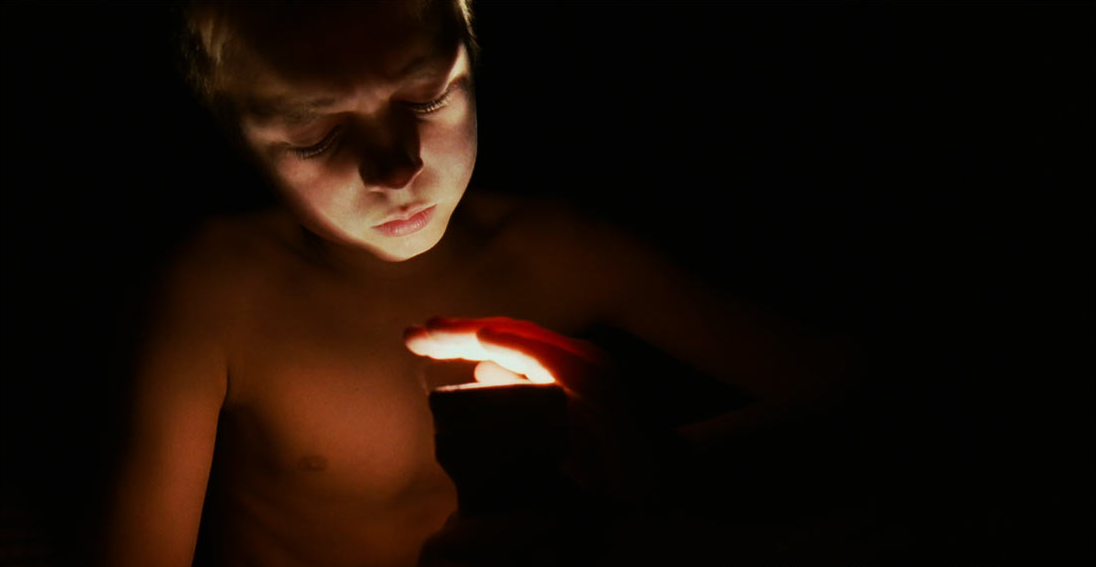
At the beginning and the conclusion — alpha and omega — we gaze on a flickering flame that can only represent the creator. Not Mr. Malick (who prefers to remain unseen in public) but the elusive deity whose presence in the world is both the film’s overt subject and the source of its deepest, most anxious mysteries. With disarming sincerity and daunting formal sophistication “The Tree of Life” ponders some of the hardest and most persistent questions, the kind that leave adults speechless when children ask them. In this case a boy, in whispered voice-over, speaks directly to God, whose responses are characteristically oblique, conveyed by the rustling of wind in trees or the play of shadows on a bedroom wall. Where are you? the boy wants to know, and lurking within this question is another: What am I doing here?
“Here” in this case is Waco, Tex., in the 1950s, a slice of earthly reality rendered in exquisite detail by the production designer, Jack Fisk, and the cinematographer, Emmanuel Lubezki. Their evident devotion to Mr. Malick’s exacting, idiosyncratic vision — the care with which they help coax his ideas into vivid cinematic reality — is in its way as moving as the images themselves, which flow and sway to equally sublime music. (The score is by Alexandre Desplat. He holds his own in some pretty imposing company, including Couperin, Brahms and Berlioz, part of whose great “Requiem” underpins an ecstatic celestial climax.) The sheer beauty of this film is almost overwhelming, but as with other works of religiously minded art, its aesthetic glories are tethered to a humble and exalted purpose, which is to shine the light of the sacred on secular reality.
Embedded in the passages of cosmology, microbiology and spiritual allegory is a story whose familiarity is at least as important to the design of “The Tree of Life” as the speculative flights that surround it. The world of neatly trimmed lawns and decorous houses set back from shaded streets is one we instinctively feel we know, just as we immediately recognize the family whose collective life occupies the central 90 minutes or so of the film.
The particulars of these people — Mr. and Mrs. O’Brien and their three sons — and of the place they inhabit are drawn from Mr. Malick’s own biography, but they also have an almost archetypal cultural resonance. This is small-town America in the ’50s: Dad’s crew cut, Mom’s apron, the kids playing kick the can in the summer dusk.
To some extent this tableau — words can hardly do justice to the honeyed sunlight streaming through kitchen windows and refracted through the spray of garden hoses, or to the loose-limbed rhythms of children at play — offers an idealized glimpse of a lost Eden. But it would be a mistake simply to bask in (or to sneer at) Mr. Malick’s nostalgia for the vanished world of his Eisenhower-era childhood.
In his view, rooted in an idiosyncratic Christianity and also in the Romantic literary tradition, the loss of innocence is not a singular event in history but rather an axiom of human experience, repeated in every generation and in the consciousness of every individual. The miraculous paradox is that this universal pattern repeats itself in circumstances that are always unique. And so this specific postwar coming-of-age story, quietly astute in its assessment of the psychological dynamics of a nuclear family in the American South at the dawn of the space age, is also an ode to childhood perception and an account of the precipitous fall into knowledge that foretells childhood’s end. It is like Wordsworth’s “Intimations of Immortality” transported into the world of “Leave It to Beaver,” an inadequate and perhaps absurd formulation but one that I hope conveys the full measure of my astonishment and admiration.
The center of the film’s universe — Mr. Malick’s eyes and ears and alter ego — is Jack O’Brien. We first meet him, in the person of Sean Penn, as a middle-aged architect who lives amid gleaming skyscrapers and clean, ultramodern surfaces and who is haunted by the death, many years earlier, of his younger brother. The opening scenes take us briefly back to Jack’s youth, acquainting us with his parents (Brad Pitt and Jessica Chastain) and allowing their grief over the loss of their son to cast a shadow of tragedy over everything to follow.
What follows most immediately is the creation of the universe, which arrives (no matter how many times you have read about it) as something of a surprise. How did we get here? There is a scene in Spike Jonze and Charlie Kaufman’s “Adaptation” in which Nicolas Cage’s terminally blocked screenwriter, looking for a place to begin a new script, is cast back to the origins of the universe, which after all is where every story commences. Mr. Malick enacts a more earnest, grander version of the same insight, acknowledging the expansive, regressive logic of simple curiosity. “Where are you?” Jack asks, of his brother and God, and the scale of his longing demands a cosmic response.
But that response will only make sense if it touches down, once again, in Jack’s own experience. In a lovely, surrealist touch, he is imagined emerging from an underwater house and swimming toward the sunlight on the surface, and then he is an infant, cradled in his mother’s arms. Before long a brother arrives, and then another, and the world makes room for them.
There are very few films I can think of that convey the changing interior weather of a child’s mind with such fidelity and sensitivity. Nor are there many that penetrate so deeply into the currents of feeling that bind and separate the members of a family. So much is conveyed — about the tension and tenderness within the O’Brien marriage, about the frustrations that dent their happiness, about the volatility of the bonds between siblings — but without any of the usual architecture of dramatic exposition. One shot flows into another, whispered voice-over displaces dialogue, and an almost perfect domestic narrative takes shape, anchored in three extraordinarily graceful performances: Mr. Pitt, Ms. Chastain and, above all, Hunter McCracken, a first-timer who brings us inside young Jack’s restless, itching skin.
“The Thin Red Line” (1998) and “The New World” (2005) — films that heralded Mr. Malick’s re-emergence after two decades of silence — took established genres and well-known moments in American history and turned their commonplaces into something new and strange. The Pacific theater in World War II and the British colonization of North America (the war movie and the western, more or less) became unlikely but curiously persuasive settings for meditations on the human connection to and estrangement from the natural world. “The Tree of Life” does something similar in a more intimate, less self-consciously epic register, staking out well-traveled territory and excavating primal, eternal meanings.
This movie stands stubbornly alone, and yet in part by virtue of its defiant peculiarity it shows a clear kinship with other eccentric, permanent works of the American imagination, in which sober consideration of life on this continent is yoked to transcendental, even prophetic ambition. More than any other active filmmaker Mr. Malick belongs in the visionary company of homegrown romantics like Herman Melville, Walt Whitman, Hart Crane and James Agee. The definitive writings of these authors did not sit comfortably or find universal favor in their own time. They can still seem ungainly, unfinished, lacking polish and perfection. This is precisely what makes them alive and exciting: “Moby-Dick,” “Leaves of Grass,” “The Bridge” and “A Death in the Family” lean perpetually into the future, pushing their readers forward toward a new horizon of understanding.
To watch “The Tree of Life” is, in analogous fashion, to participate in its making. And any criticism will therefore have to be provisional. Mr. Malick might have been well advised to leave out the dinosaurs and the trip to the afterlife and given us a delicate chronicle of a young man’s struggle with his father and himself, set against a backdrop of rapid social change. And perhaps Melville should have suppressed his philosophizing impulses and written a lively tale of a whaling voyage.
But the imagination lives by risk, including the risk of incomprehension. Do all the parts of “The Tree of Life” cohere? Does it all make sense? I can’t say that it does. I suspect, though, that sometime between now and Judgment Day it will.
“The Tree of Life” is rated PG-13 (Parents strongly cautioned). Birth, death, the end of the world.
The pair frequently move around the world due to the hectic demands of their movie careers and their kids aged two to nine go with them.
But when it comes to luggage, stunning Angelina - often branded a "supermum" for juggling work, looking after the kids and campaigning so effortlessly - takes a tough approach.
In a wide-ranging interview about their unique family life, Brad, 47, revealed: "We're quite comfortable living out of suitcases, we're quite nomadic.
"We've got it down and the kids have got their backpack. They have to carry their backpack and if they forget it, they forget it - because there's just too much to keep track of.
"Mom's really good at the packing. She's militant, she's really, really talented. I couldn't do it.
"We have a base camp in LA and we're trying to establish a base camp here in France which can be a hub for going to other places in the world.
"But they're quite used to it. We try to travel at night so they sleep because it's really difficult for everyone to be awake and the chaos that ensues.
"We always take them to the location. We try to keep the family intact - we think it's very important." Brad explains that Angelina will "hopscotch" her work schedule with his so one of them will always be at home.

He adds: "The thing I'm most proud of I think is that the biggest part of our kids' education is getting to see the world and getting to experience the world and other cultures."
The Jolie-Pitt brood consists of Maddox, nine, adopted from Cambodia, Pax, seven, adopted from Vietnam, Zahara, six, adopted from Ethiopia and biological children Shiloh, four, and twins Knox and Vivienne, two.
And Brad admits that while his children don't quite understand what he and Angelina, 35, do for work, becoming a dad has been the biggest role he has taken on by far.
He explained: "They know mom and dad tell stories and make movies but they don't really know what it is because they haven't seen it and they're not impressed by it.
"It's just what mom and dad do and it's a bummer when mom's got to go to work, you know, or when dad's got to go to work.
"Becoming a father certainly changed the way I choose films because I'm very aware they are going to see them one day.
"I want them to be proud of their dad in the end, when they grow up and figure out what we actually do for a living."
Earlier this week Brad's latest film, The Tree Of Life, won the Palme d'Or, the most important prize at the Cannes Film Festival.
Directed by The Thin Red Line's Terrence Malick and set in Texas in the 1950s, the movie revolves around the relationship between a father and son. Brad plays a loving but stern dad Mr O'Brien, while Sean Penn is his grown-up son, Jack, who reflects on the people and moments that helped shaped his life.
Acting in a film which centres around a dad's bond with his kids left Brad thinking about his own relationship with his sons and daughters.

He said: "It's so obvious to me that when I come home my kids are aware of everything that's going on.
"They say actions speak louder than words and it's even more true with my kids.
"So it's quite important for me not to put my frustrations on them or bring them to the door. I want to keep them free, not burdened with my junk.
"In the film it's the exact opposite of that. It is a very sad man who feels embittered by his situation, doesn't feel like he's able to get ahead, always feels like he's on the losing end and feels quite oppressed by his surroundings and predicament.
"He doesn't know why it isn't working out for him when it is working out for other people."
Earlier this year it was reported that Brad and Angelina, who met while filming 2005 action-comedy Mr & Mrs Smith, spend £6million a year on nannies, tutors and chartering private jets for their children.
But for Brad, the most important thing in life is now his kids' wellbeing.
He said: "It's changed everything. I'm scared of death, sure, aren't we all?
"Who's not? I mean, I don't want to go just yet but it is a reality we all live with. And it's something I'm more concerned with being a father and I'm more concerned with being safe and that they're safe.
"In fact, it's my only fear - where I used to be more concerned with myself, now I don't give a s***. I just want to make sure everyone's OK."

Despite being many women's ideal pin-up, Brad didn't concentrate on staying in shape for his latest role.
He said: "I just ate a lot and drank a lot of beer for that Mid-West, kind of corn-fed look."
And making The Tree Of Life gave Brad the chance to work with Penn - one of the actors he admires most in Hollywood.
Brad revealed: "Sean is one of the reasons I started acting. Sean was one of my gods when I was trying to figure out how to do it, what I wanted to do, what kind of films I want to do.
"He's got a ferociousness that I've still yet to attain, he's one of those few greats that is capable of being quite fierce and yet having great love.
"He holds these two contradictory parts in his performances and I find that most interesting."
Since his first major movie role in 1991, as the seductive cowboy hitchhiker in road movie classic Thelma & Louise, Brad has become a staple on our cinema screens.
From box office hits such as Ocean's 11 in 2001 to more thought-provoking films such as The Tree Of Life, Brad believes his roles are getting more daring as he gets older.
He said: "I'm not discounting the comedy and the action films because those mean something to my kids too - we bond over those films.
"I'm not being more cautious. I'm maybe being more adventurous. I want it to mean something - I want it to mean something to the children. I think that before I enjoyed more colourful characters and now I want them to know their dad has a maturity.
"I want to do stories where I can make a difference - not a difference in the world - but stories where you couldn't just plug any actor into the role, where I've got something to add. Otherwise, why do it?"
The wait is over! Terrence Malick's hotly anticipated THE TREE OF LIFE is out in select theaters on May 27th. Here where and when it will be showing near you!
5/27/11
NEW YORK
Lincoln Plaza, New York, NY
Sunshine Cinemas, New York, NY
LOS ANGELES
The Landmark, Los Angeles, CA
Pacific Arclight Hollywood, Hollywood, CA
6/2/11
SAN FRANCISCO, CA
Embarcadero Center Cinemas, San Francisco, CA
THE TREE OF LIFE will be going wide nationally on 7/8/11. Keep checking this page for updates! Also note: Fox Searchlight is only handling the US distribution of the movie.
Alright, by popular demand (not really), we have yet another post on this tiny, little picture by Terrence Malick called “The Tree Of Life” you may have heard about. We’ve gotten our hands on a list of all the music that’s utilized in the film (the score is its own thing though).
Perhaps the most memorable music from this list will be “Siciliana Da Antiche Danze Ed Arie Suite III” by Ottorino Respighi and “My Country –Vltava (The Moldau)” by composer Bedrich Smetanaboth of which are featured in the original “Tree Of Life” trailers. Mostly meditative choral pieces, requiems, slowly growing classical or opera pieces and occasionally something more trance-inducing and ambient, the music isn’t something you’re likely going to rock on your iPod (ok, maybe some tracks before bed), but if you want a quick peek window into the mood, tone and timbre of Malick’s latest picture, the music below will definitely guide you there. Perhaps one of the more interesting uses of music is Arsenije Jovanovic, a Serbian radio-art composer who weaves voices, instruments, field recordings and manipulated sound into his natural environment compositions.
Yes, this music is, in a sense, spoiler-ish if you want to go into Malick’s temple unfeathered and with a puuuure experience (don’t forget to splash yourself with holy water and kiss the feet of the Malick statue, yo), but if you want to get a quick taste of the angelic, heavenly and gorgeously divine music in the film that’s not the original score composed by Alexandre Desplat, the list of music in the film, and some accompanying youtube clips when available, are below.
“Funeral Canticle”
Written by John Tavener and Mother Thekla
Performed by George Mosley, Paul Goodwin
and the Academy of Ancient Music
“Cosmic Beam Take 5”
Written and Performed by Francesco Lupica
“Symphony No. 1”
Written by Gustav Mahler
Performed by the Polish National Radio Symphony Orchestra conducted by Michael Halász
“Morning Prayers”
Written by Giya Kancheli
“Faunophonia Balkanica”
Written, Performed and Produced by Arsenije Jovanovic
“Wind Pipes”
Written and Performed by Michael Baird
“Approaching”
Written, Performed and Produced by Arsenije Jovanovic
“Ta Há 1”
Written and Performed by Klaus Wiese
“Snapshot from the Island”
Written and Performed by Tibor Szemzo
“Lacrimosa 2”
Composed by Zbigniew Preisner
Performed by Elzbieta Towarnicka (soprano) and the Sinfonia Varsovia
and the Varsov Chamber Choir, conducted by Jacek Kaspszyk
“Troops Advance in Grass”
Written and Performed by Francesco Lupica and Lee Scott
“Ascending and Descending”
Written by David Hykes
Performed by David Hykes and The Harmonic Choir
“Resurrection in Hades”
Written by John Tavener and Mother Thekla
Performed by Joseph Jennings and the Chanticleer Choir and Chorus
“Berlioz: 7. Domine Jesu Christe [Requiem Op. 5 (Grande Messe des Morts)]”
Performed by Wandsworth School Boys Choir, London Symphony Chorus, London Symphony
Orchestra, Sir Colin Davis
“Siciliana Da Antiche Danze Ed Arie Suite III”
Written by Ottorino Respighi
Performed by the National Symphony Orchestra of Ireland Conducted by Rico Saccani
“Hymn to Dionysus”
Composed by Gustav Holst
Performed by The Royal Philharmonic Orchestra and Chorus
“My Country –Vltava (The Moldau)”
Composed by Bedrich Smetana
Performed by Vaclav Smetacek and
The Czech Philharmonic Orchestra
“Brahms: 2. Andante moderato [Symphony No. 4 in E minor, Op. 98]”
Performed by Berliner Philharmoniker, Herbert von Karajan
“Symphony No. 3”
Written by Henryk Górecki
Performed by the Polish National Radio Symphony Orchestra conducted by Antoni Wit
“Pièces de clavecin, Book II 6e Ordre N°5:
Les Barricades Mistérieuses
Written by Francois Couperin (1668-1733)
Performed by Angela Hewitt
“J.S Bach: Fugue [Toccata and Fugue in D Minor, BWV 565]”
Performed by Helmut Walcha
“The Well-Tempered Clavier”
Written by Johann Sebastian Bach
Performed by Jeno Jandó
“Pièces de clavecin, Book II 6e Ordre N°5:
Les Barricades Mistérieuses
Written by Francois Couperin
Performed by Hanan Townshend
“Hymn 87: Welcome Happy Morning”
Performed by Hanan Townshend
“Mussorgsky: Pictures at an Exhibition - Promenade - The Tuileries - Bydio (Piano Version)”
Performed by Vladimir Ashkenazy
“Schumann: 1. Allegro affettuoso [Piano Concerto in A Minor, Op. 54]”
Performed by Martha Argerich, Gewandhausorchester, Leipzig, Riccardo Chailly
“Klangschalen 2”
Written and Performed by Klaus Wiese
“Eternal Pulse”
Written and Performed by Hanan Townshend
“After the Rain: Antiphon”
Written by Barry Guy
Performed by Richard Hickox and the City of London Sinfonia
“Harold in Italy”
Written by Hector Berlioz
Performed by the San Diego Symphony Orchestra conducted by Yoav Talmi
“Piano Sonata No.16 in C Major K. 545”
Composed by Wolfgang Amadeus Mozart
Performed by Jim Lynch
“Siciliana Da Antiche Danze Ed Arie Suite III”
Written by Ottorino Respighi
Performed by Hanan Townshend
“Lacrimosa 2”
Written by Zbigniew Preisner
Performed by Hanan Townshend
“Berlioz: 10. Agnus Dei [Requiem, Op. 5 (Grande Messe des Morts)]”
Performed by Wandsworth School Boys Choir, London Symphony Chorus, London Symphony
Orchestra, Sir Colin Davis
“Sound Testament of Mount Athos”
Written, Performed and Produced by Arsenije Jovanovic
“Ma Maison”
Written, Performed and Produced by Arsenije Jovanovic
Courtesy of Arsenije Jovanovic
Since we did all this work, maybe one of you can provide us with an mp3 playlist of all the songs? “The Tree Of Life” hits theaters in limited release on Friday, May 27th.
Edward Davis posted
Over this past weekend, the combined perfs of debuts "Bridesmaids" and "Priest" along with holdover titles "Thor" and "Fast Five" helped weekend totals keep up with, if not run a smidgen ahead of, the comparable 2010 sesh. The weekend before was down roughly 11% from last year, unable to catch the $128 million opening for "Iron Man 2," but "Fast Five" led a massive 56% uptick over the weekend of April 29.
Now it's Disney's opportunity to help turn the B.O. tide, with "Pirates of the Caribbean: On Stranger Tides" set to bow worldwide this weekend. The film is high on most moviegoers' must-see lists and is expected to open to boffo biz, with tracking suggesting it'll exceed "Shrek Forever After," which opened the same weekend last year with $70.8 million. (The "Pirates" franchise's second installment, "Dead Man's Chest, opened to $135 million; the third, "At World's End," bowed to $114 million.)
Joel Cohen, CEO of Movietickets.com, described "Pirates" -- and other forthcoming franchise titles such as "Transformers: Dark of the Moon" -- as "home runs."
"If you look at the upcoming titles, they're guarantees," he said, adding that Memorial Day-weekend offerings "The Hangover Part II"and "Kung Fu Panda 2" characterize the summer as ideal counterprogramming. "That's the most impressive part of this summer. I've never seen a summer that's been put so well together."
One possible snag for B.O. optimists is that with major releases piled on top of each other all summer long, even the biggest titles won't have much room to run beyond opening weekend. Studios will need to rely on counterprogramming to afford any breathing room -- much like Disney's "Toy Story 3" was able to play alongside Summit's "The Twilight Saga: Eclipse," which launched just two weeks after "Toy" last year.
This year, Disney-Pixar's "Cars 2" bows the same week as Sony's R-rated "Bad Teacher," and a week before Paramount's "Transformers." Pics like "Hangover II" and Paramount's "Super 8," which bows on June 10 after "X-Men: First Class," are being tubthumped as potential fanboy-frenzy starters.
That's important, because success this summer won't rely solely on how these potential blockbusters open but how they play throughout the season.
From Lainey

Brad Pitt plays an angry father in “The Tree of Life,” Terrence Malick's rumination on life itself, which elicited a decidedly mixed reaction at Cannes this week.
“The Tree of Life” is Mr. Malick’s first film since “The New World” (2005), a title that could work for this new movie as well. Running 2 hours 18 minutes, it is a personal, impressionistic work — beautiful, nonlinear, trippy, flawed — that unfolds largely in fragmented flashbacks, tracing not only the arc of a single life but also that of creation itself. As the title suggests, Mr. Malick has nothing less in mind than the origin of life, a beginning (or Beginning) in which vaporous swirls, gurgling lava and fiery explosions give way to the sight of a meteor hitting a planet (presumably Earth), an explosive vision that Mr. Malick audaciously, riskily, joins with the image of a pregnant woman’s belly.
The issue isn’t merely that Mr. Malick visually connects the impregnated planet, as it were, and the expectant woman, an association that sets a Mother Earth motif in motion. It’s also in the seriousness and sincerity with which he makes this connection: The film is an affirmation of Mr. Malick’s belief in the power of cinematic images to express the sublime (the cinematographer is Emmanuel Lubezki) and, perhaps, of his faith in the audience to meet him with equivalent seriousness.
It also serves as a reminder of how few contemporary filmmakers engage questions of life and death, God and soul, and risk such questioning without the crutch of an obvious story. It isn’t that these life questions aren’t asked in our movies; they are, if sometimes obliquely. Rather it’s the directness of Mr. Malick’s engagement with them that feels so surprising at this moment, and that goes against the mainstream filmmaking grain.
It’s this bluntness, along with the stunning, kaleidoscopic images of outer space (some derived from the Cassini mission to Saturn), that summoned up for me Stanley Kubrick’s cosmic explorations in “2001: A Space Odyssey.” Certainly the films are different — formally, experientially, qualitatively — yet each also concerns concepts of God. In “2001” God has been replaced by science, which with the emergence of the monolith, is ultimately confronted by a different (extraterrestrial) God altogether. In “The Tree of Life,” God is everywhere and nowhere — in a ray of sun, a blade of grass.
The film opens with a quotation from the Book of Job — “Where were you when I laid the foundations of the Earth?” — taken from a passage in which God, like a hectoring, aggrandizing father, challenges Job with questions. It’s a section that Walt Whitman, as readers of the poet have long pointed out, seems to answer in “Song of Myself” (“In the faces of men and women I see God, and in my own face in the glass”), a work that Mr. Malick may have drawn on, given how both the poem and the film exult in a cosmic oneness with the world and are more circular in form than linear. Any number of the poem’s lines (“The play of shine and shade on the trees as the supple boughs wag”) could describe images from the film.
The rest emerges elliptically, including an early scene of a woman, Mother (Jessica Chastain), receiving terrible news of a death. Shortly after in film time, though years later, her oldest son, Jack (Sean Penn), now middle-aged, reflects on his childhood, a meditation that involves fiery visions of primordial life (dinosaurs included) and leads to the image of his mother’s pregnant belly. This family portrait eases the film into a sustained, mostly pacific interlude from Jack’s childhood with his two brothers, mother and father (Brad Pitt). It’s an imperfect Eden, however, one in which an angry father and gentle mother roam instead of dinosaurs, and, for better and sometimes worse, embody the tug between nature (a father’s harshness) and grace (a mother’s love). It’s a beautiful if hermetic vision that I admire for its ambition if finally not for its philosophy.
Prehistoric and cosmic visions aside, Terrence Malick's film is an unashamedly epic reflection on love and loss


Terrence Malick's mad and magnificent film descends slowly, like some sort of prototypical spaceship: it's a cosmic-interior epic of vainglorious proportions, a rebuke to realism, a disavowal of irony and comedy, a meditation on memory, and a gasp of horror and awe at the mysterious inevitability of loving, and losing those we love.
Sean Penn has a central but minor role as Jack, a careworn 21st-century corporate executive who is now disenchanted with his life. At the moment of crisis, he is carried back to an ecstatically remembered 1950s boyhood in smalltown America. He remembers his relationship with his demanding, disciplinarian father, played by Brad Pitt, and the brother who died at the age of 19: the news is brought to his distraught mother (Jessica Chastain) via an official communication – the telegraph delivery boy thrusts it into her hands and walks quickly away – so he appears to have died on military service.
Jack realises that time, far from healing the wounds of loss, only makes them more painful. Along with the dream-lit tableaux from his childhood, he is vouchsafed extraordinary visions of geological time and the unknowable reaches of the universe, in comparison with which his loss is meaningless. And yet meaning has to be found if the pain is not to be unendurable. In a sense, the purpose of these gigantic visions is to anaesthetise the pain of being alive and not understanding.
Brad Pitt dominates the bulk of the film as Mr O'Brien, who appears on the face of it to be a God-fearing family man with a button-down shirt and crewcut, brusquely but sincerely in harmony with his gentle, beautiful and profoundly religious wife. Chastain has a voiceover at the very beginning asking her sons to prefer God's grace to the beauties of nature, as the truer path. But O'Brien is far more complex than first appears: he is angry with his boys; he respects the severity of traditional churchgoing belief, but aspires to riches and worldliness, taking out patents in the aeronautics industry and dissipating the family's means in the process.
He challenges his boys to hit him, to toughen them up, and does not hesitate to hit them for disobedience and discourtesy. He plays the organ in church and is a disappointed musician; his frustration and rage simmer from every pore. His boys feel fear as well as love: Malick shows how they have fused into the same emotion. They are encouraged to respect his violence and secretly to feel contempt for their mother's gentleness, and yet their fascinated alienation expresses itself in one startling scene involving an incursion into the parental bedroom.
And there are the baffling and bizarre symphonic passages of non-narrative spectacle, prehistoric jungles, arid deserts, galaxies and spiral shapes – Kubrickian landscapes of wonder. Weirdest of all is the engorged river in which a wounded dinosaur lies prostrate; another dinosaur comes along, plants its great foot on the other's neck and then moves heedlessly on. Is this the only message of the universe – pure survival? But then how is it we want something other than survival? What do we want to survive for? And Malick appears, through sheer crazy excess, to bring his movie closer to the ultimate question: why does anything exist at all?
This film is not for everyone, and I will admit I am agnostic about the final sequence, which suggests a closure and a redemption nothing else in the film has prepared us for. But this is visionary cinema on an unashamedly huge scale: cinema that's thinking big. Malick makes an awful lot of other film-makers look timid and negligible by comparison.

And while more stream and brooks of memory than traditional narrative, “Tree Of Life” is not without its story and though the picture wanders restlessly, aggravated with itself like the testy and tempestuous children in the family in search of love, approval and belonging, there is a good 40-minute chunk that begins around the 2/3rds mark (forget acts) that’s devoted to the film’s core family.
Maddening at its core is the sense that Malick’s fluttered breath picture teeters on the edge of a luminous greatness never before captured in cinema, but it fails to ascend to those lofty heights. It’s a gorgeously expressive film unable to articulate itself and the inexpressible. Whenever the picture tends to settle into a tonal groove it quickly dims itself like wind blowing out a candle. Notions that the film devolves into self-parody are, in the writers opinion, incredibly overblown, however the Sean Penn sequences are the weakest and the easiest to invite ridicule. But the ambitious picture isn’t any more pretentious than past Malick film’s it’s just more, well, ambitious and much grander in scope.
Yes, like many of Terrence Malick’s film “The Tree Of Life” may age like fine wine, but there’s no denying while its heart and soul are like a peek into God’s window, it is but a flirtatious glance and ultimately unsatsifying; its tricky ending moving, but not quite as angelic and heart-stirring as it (and we) wants (want it) to be. Echoing similar visuals and themes from Darren Aronofsky‘s “The Fountain,” one can argue, while very different, Malick’s picture is less successful in its aims as it communicates rage, longing, love, resent and questions about the universe and the meaning of life, but it never amounts to too much other than fleeting emotions and feelings.
Oscar talk for this picture will surely fade come the fall unless serious contenders fail to emerge; its just not that kind of picture (but Pitt may have a shot). Fox Searchlight has a difficult sell on their hands as evinced already from the somewhat mixed reaction out of the arthouse-friendly Cannes critics. Malick preaches to his apostle-like choir and most of them will swoon with every note, but it’s possible this picture could be even less financially successful than his previous efforts. One gets the sense that throughout the miles and miles of footage that was shot, a near-perfect, more traditional Malick picture exists, but unfortunately, its not the one that’s up there on the screen.
Still, for all its minor, but aggravating issues—again, this is a picture that hints toward pure cinematic divinity, but doesn’t quite get there—Terrence Malick’s “The Tree Of Life” is a truly powerful experience that invites multiple viewings and interpretations and the filmmaker has not lost the skill to deliver awe-inspiring sequences. Arguably the reason why this picture doesn’t work is because it’s Malick’s angriest film (hear me out, this is relative). The sea churns, the universe cries itself awake like a difficult birth in its Nova episode-like creation sequences and these somber (and jaw-dropping visual scenes) echo the themes of childhood and and parental resent and lingering emotional disquietude. An overall melancholy, yet frustrated mien seems to stir in its troubled heart asking the unanswerable questions: why does the beauty of life give us so much pain? And why if it’s ultimately worth all that hardship must it end? There’s a lot to love in Malick’s soul-searching, meaning-of-life questioning almost-masterpiece, but its obliqueness, does sometimes keep us one step emotionally removed. One thing’s for sure, the wildly praising and dismissive reviews (particularly J. Hoberman’s) are the biggest disservice to Malick’s work and the film itself and to outright lump it all together as a success or failure and leave it at that misses the point completely. [B]