Thank you Angelina Jolie for a great discussion and your empathy towards those in greatest need.⁰⁰With displacement at a record high, your commitment to humanitarian work in tough places means a lot.⁰⁰Humanitarian action must be driven by practical solutions & with dignity. pic.twitter.com/BAmmnI4DGP
— Tom Fletcher (@UNReliefChief) June 15, 2025
Showing posts with label UN. Show all posts
Showing posts with label UN. Show all posts
Sunday, June 15, 2025

Thursday, October 22, 2020
At today's @UNESCO #GlobalEducation Meeting, #AngelinaJolie powerfully advocated for #education funding, safeguarding against private companies in education & involving the most disadvantaged children in the global education conversation. pic.twitter.com/2qRHZOeYK2
— GCE-US (@GCE_US) October 22, 2020


Wednesday, September 26, 2018
‘The UN needs a new body to investigate war crimes.’ Read my latest @Telegraph article with Angelina Jolie https://t.co/jeHNObZq8G #PSVI #UNGA18— William Hague (@WilliamJHague) September 26, 2018
Lord William Hague and Angelina Jolie are co-founders of the Preventing Sexual Violence In Conflict Initiative, a global campaign to end the use of rape as a weapon of war
Sunday, March 4, 2018
Lies, Damned Lies, and One Very Misleading Statistic https://t.co/nT0MyCdfb4— Arwa Damon (@arwaCNN) March 4, 2018
Wednesday, March 15, 2017
‘I’m with you for life.’ Special Envoy Angelina Jolie reaffirms commitment to refugees worldwide on visit to UNHCR https://t.co/vF7BmgSVzl pic.twitter.com/meD2cPsRRM— UNHCR United States (@UNHCRUSA) March 15, 2017

Thanks to Pride&Joy

Angelina Jolie arrives in Geneva to give an impassioned speech at the @UN https://t.co/TnEzPS9Xkq pic.twitter.com/tWJVh6WMw9— ET Canada (@ETCanada) March 16, 2017
Angelina Jolie leaving UN in Geneva after speech pic.twitter.com/xHghPrO1hm— Stephanie Nebehay (@StephNebehay) March 15, 2017
Missed Angelina Jolie @RefugeesChief #WithRefugees?— UN Web TV (@UNwebcast) March 15, 2017
📺Watch Full Lecture in English https://t.co/ld4N2Afig4 & French https://t.co/T5eEot498C pic.twitter.com/cUntJyCchC
photos daily mail


Vanity Fair
United Nations
Exclusive: Angelina Jolie Calls on World Leaders to Reject Fear in the Age of Trump
Amid a rising tide of nationalism in the West, and the worst refugee crisis since World War II, U.N. Special Envoy Angelina Jolie
on Wednesday delivered a forceful speech in defense of
internationalism. Speaking in Geneva at the Sergio Vieira de Mello
Foundation, named after the U.N. diplomat killed in Iraq in 2003, Jolie
called for citizens around the world to reject the politics of exclusion
and embrace their global responsibilities, even if their governments do
not. Here, provided exclusively to Vanity Fair, is the full text of Jolie’s address, as prepared for delivery.
15 March 2017, Palais Des Nations, Geneva
We
are here in memory of Sergio Vieira de Mello and the 21 other men and
women, most of them UN workers, who died with him in the bombing of the
UN Headquarters in Baghdad in August 2003.
We
remember all those who died, to acknowledge each valuable life cut
short, and the families who share, even today, in their sacrifice.
We
also remember them for the power of the example they set: brave
individuals from 11 different countries, working to help Iraqi people,
at the direction of the United Nations Security Council, and on behalf
of us all.
This is sometimes forgotten: that in serving under the UN flag they died in our names, as our representatives.
At their head was Sergio Vieira de Mello, a man of extraordinary grace and ability, as so many who knew him testify.
A
man who gave 30 years to the United Nations, rising from a field
officer to High Commissioner for Human Rights and Special Representative
to Iraq.
From Bangladesh and Bosnia to South Sudan to East
Timor, he spent the majority of his career in the field, working
alongside people forced from their homes by war, and assisting them with
his skill as a diplomat and negotiator.
Perhaps the greatest testament to his contribution, is how much his advice would be valued today.
As
the Syrian conflict enters its seventh year, as we live through the
gravest refugee crisis since the founding of the United Nations, as 20
million people are on the brink of death from starvation in Yemen,
Somalia, South Sudan and northeast Nigeria, I cannot imagine that there
is anyone in the leadership of the United Nations who would not welcome
the opportunity to consult Sergio, or send him into the field once more.
He is truly missed, even today.
It is humbling for me to speak tonight in the presence of members of Sergio’s family and his former colleagues.
I never knew Sergio, but I have stood before the plaque in the place where he died.
I
felt profound sadness at the fact that the conflict in Iraq – the
source of so much Iraqi suffering to this day - had claimed the lives of
men and women whose only intention was to try and improve a desperate
situation.
But I also saw clearly the value and nobility of a life spent in service of others.
Sergio
was a man who never turned down an assignment, no matter how difficult
and dangerous - or as others have put it, was “handed one impossible
task after another”.
He was a man, to borrow the words of Thomas Paine, whose country was the world, and whose religion was to do good.
He will always remain a hero and inspiration to all who follow in his footsteps.
The UN’s work did not end there, in the rubble of the Canal Hotel, 14 years ago.
Hundreds
of UN staff have served, and continue to, serve in Iraq, as they do
from Afghanistan to Somalia, because the task of building peace and
security can never be abandoned, no matter how bleak the situation.
My
thoughts on Sergio’s life and legacy derive from my 16 years with
UNHCR, the Agency he spent so much of his career serving and
representing.
But I also speak as a citizen of my country – the United States.
I
believe all of us who work with the UN preserve this duality. The
United Nations is not a country, it is a place where we come together as
nations and people to try to resolve our differences and unite in
common action.
As a citizen, I find myself
looking out on a global environment that seems more troubling and
uncertain than at any time in my lifetime. I imagine many of you may
feel the same.
We are grappling with a level of
conflict and insecurity that seems to exceed our will and capabilities:
with more refugees than ever before, and new wars erupting on top of
existing conflicts, some already lasting decades.
We
see a rising tide of nationalism, masquerading as patriotism, and the
re-emergence of policies encouraging fear and hatred of others.
We
see some politicians elected partly on the basis of dismissing
international institutions and agreements, as if our countries have not
benefited from cooperation, but actually been harmed by it.
We
hear some leaders talking as if some of our proudest achievements are
in fact our biggest liabilities – whether it is the tradition of
successfully integrating refugees into our societies, or the
institutions and treaties we have built rooted in laws and human rights.
We
see nations that played a proud role in the founding of the
International Criminal Court withdrawing from it, on the one hand, and
on the other, we see arrest warrants for alleged war crimes issued but
not implemented, and other crimes ignored altogether.
We
see a country like South Sudan ushered by the international community
into independence, then largely abandoned – not by the UN agencies and
NGOs – but effectively abandoned, without the massive support they
needed to make a success of sovereignty.
And we
see resolutions and laws on the protection of civilians and the use of
chemical weapons, for instance, flouted repeatedly, in some cases under
the cover of Security Council vetoes, as in Syria.
Many
of these things are not new – but taken together – and in the absence
of strong international leadership, they are deeply worrying.
When we consider all this and more, as citizens, what is our answer?
Do we, as some would encourage us to think, turn our backs on the world, and hope we can wait for storms to pass?
Or do we strengthen our commitment to diplomacy and to the United Nations?
I
strongly believe there is only one choice, demanded by reason as well
as by conscience, which is the hard work of diplomacy and negotiation
and reform of the UN
This is not to say that that is any way an easy road. And there are reasons people feel insecure today.
The
level of conflict and lack of solutions combined with the fear of
terrorism; the reality that globalization has bought vast benefits to
some but worsened the lot of others; the sense of a disconnect between
citizens and governments, or in some countries the lack of governance;
the overall feeling that for all our gains in technology and
connectedness, we are less in control of forces shaping our lives – all
these factors and more have contributed to a sense of a world out of
balance, and there are no easy answers.
And despite the millions of people who have lifted
themselves out of poverty in our lifetimes, the difference between the
lives of those of us born in wealthy, democratic societies and those
born into the slums and refugee camps of the world is a profound
injustice. We see it and we know it to be wrong, at a simple human
level. That inequality is contributing to instability, conflict and
migration as well as to the sense that the international system serves
the few at the expense of the many.
But again, what is our answer, as citizens?
Do we withdraw from the world where before we felt a responsibility to be part of solutions?
I am a proud American and I am an internationalist.
I believe anyone committed to human rights is an internationalist.
It means seeing the world with a sense of fairness and humility, and recognizing our own humanity in the struggles of others.
It stems from love of one’s country, but not at the expense of others - from patriotism, but not from narrow nationalism.
It
includes the view that success isn't being better or greater than
others, but finding your place in a world where others succeed too.
And that a strong nation, like a strong person, helps others to rise up and be independent.
It
is the spirit that made possible the creation of the UN, out of the
rubble and ruin and 60 million dead of World War Two; so that even
before the task of defeating Nazism was complete, that generation of
wartime leaders was forging the United Nations.
If governments and leaders are not keeping that flame of internationalism alive today, then we as citizens must.
The
challenge is how to restore that sense of balance and hopefulness in
our countries, while not sacrificing all we have learnt about the value
and necessity of internationalism.
Because a
world in which we turn our back on our global responsibilities will be a
world that produces greater insecurity, violence and danger for us and
for our children.
This is not a clash between idealism and realism.
It
is the recognition that there is no shortcut to peace and security, and
no substitute for the long, painstaking effort to end conflicts, expand
human rights and strengthen the rule of law.
We
have to challenge the idea that the strongest leaders are those most
willing to dismiss human rights on the grounds of national interest. The
strongest leaders are those who are capable of pursuing both.
Having
strong values and the will to act upon them doesn’t weaken our borders
or our militaries – it is their essential foundation.
None of this is to say that the UN is perfect. Of course, it is not.
I have never met a field officer who has not railed against its shortcomings, as I imagine Sergio did in his darkest moments.
He,
like all of us, wanted a UN that was more decisive, less bureaucratic,
and that lived up to its standards. But he never said it was pointless.
He never threw in the towel.
The UN is an imperfect organization because we are imperfect. It is not separate from us.
Our
decisions, particularly those made by the Security Council, have played
a part in creating the landscape we are dealing with today.
We should always remember why the UN was formed, and what it is for, and take that responsibility seriously.
We
have to recognize the damage we do when we undermine the UN or use it
selectively - or not at all - or when we rely on aid to do the job of
diplomacy, or give the UN impossible tasks and then underfund it.
For
example today, there is not a single humanitarian appeal anywhere in
the world that is funded by even half of what is required. In fact it is
worse than that. Appeals for countries on the brink of famine today are
17%, 7%, and 5% funded, for example.
Of course, emergency aid is not the long-term answer.
No
one prefers that kind of aid. Not citizens of donor countries. Not
governments. Not refugees. They do not want to be dependent.
It would be far better to be able to invest all our funds in infrastructure and schools and trade and enterprises.
But
let’s be clear, emergency aid has to continue because many states
cannot or will not protect the rights of citizens around the world.
It is what we spend in countries where we have no diplomacy or our diplomacy is not working.
Until
we do better at preventing and reducing conflict, we are doomed to be
in a cycle of having to help feed or shelter people when societies
collapse.
As another legendary UN leader, who
was also killed in the line of duty, Dag Hammerskold, said “Everything
will be all right – you know when? When people, just people, stop
thinking of the United Nations as a weird Picasso abstraction and see it
as a drawing they made themselves”.
The UN can only change if governments change their policies. And if we as citizens ask our governments to do that.
It is moving, if you think about it: We are the future generations envisaged in the UN Charter.
When
our grandparents resolved to “spare future generations the scourge of
war”, as written in the Charter, they were thinking of us.
But as well as dreaming of our safety they also left us a responsibility.
President Roosevelt, addressing the US Congress in January 1945, six months before the end of Second World War, said this:
“In
the field of foreign policy, we propose to stand together with the
United Nations not for the war alone but for the victory for which the
war is fought”.
He went on:
“The
firm foundation can be built- and it will be built. But the continuance
and assurance of a living peace must, in the long run, be the work of
the people themselves.”
Today, we have to ask ourselves, are we living up to that mission?
They gave us that start. What have we done with it?
It
is clear to me that we have made huge strides. But our agreements and
institutions are only as strong as our will to uphold them today.
And
if we do not, for whatever reason, we bequeath a darker and more
unstable world to all those who come after us. It is not for this that
previous generations shed blood and worked so hard on behalf of all of
us.
The memory of those who came before us holds us true to our ideals.
Resting unchanging in time, they remind us of who we are and what we stand for.
They give us hope to stay in the fight, as Sergio did, until his last breath.
14
years since his death, there is a stronger need than ever before for us
to stay true to the ideals and purposes of the United Nations.
That is what I hope his memory holds us to today.
We
can’t all be Sergios. But I hope all of us can determine that we shall
be a generation that renews its commitment to “unite our strength to
maintain international peace and security”, and “to promote social
progress and better standards of life in larger freedom.”
But
in the final analysis, even if we do not, even if that level of vision
eludes us and we continue to simply manage rather than to try to
overcome our generation’s challenges, we have to keep working
determinedly and patiently.
And you can be
certain, as you do, that you follow the example of one of the UN's
finest sons: and that to do even a little of his good, to apply
ourselves to the work he left unfinished, in whatever way we can, is a
worthy task for any one of us.

At UN, Angelina Jolie laments "a rising tide of nationalism masquerading as patriotism, the re-emergence of policies encouraging fear." pic.twitter.com/ynAlmMVVxG— CBS News (@CBSNews) March 15, 2017
Pride&Joy shares:

24heures
Angelina Jolie attracts nearly 1,000 people to Geneva
--------------------------------------------------
Geneva International The envoy of the High Commission for Refugees held a conference at the Palais des Nations on Wednesday evening.
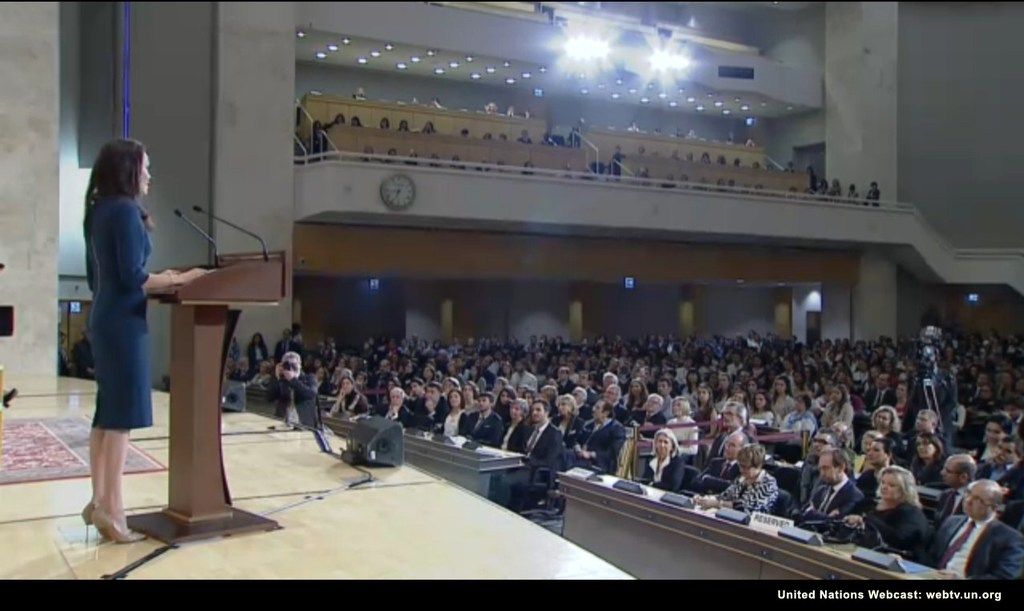
The arrival of Angelina Jolie in Geneva attracted a thousand people this Wednesday at the Palais des Nations. Many students, but also retirees and fans of the actress: people from all walks of life and all nationalities came to listen to what the star, a special envoy of the UN High Commissioner for Refugees (UNHCR) Ie in the UN compound.
After holding a conference at the London School of Economics on Tuesday on women's rights and violence during displacement, the 41-year-old American-Cambodian actress was the Geneva guest of the foundation Sergio Vieira de Mello and the Graduate Institute of International and Development Studies to honor the memory of the former High Commissioner, killed in an attack in Baghdad in 2003 at the age of 55.
At 6:15 pm, the arrival of the star, dressed in a blue dress, immediately silenced the grand hall of the Palais des Nations. In a speech of about twenty minutes, she delivered a plea in favor of internationalism and against the withdrawal of nations. Recognizing the imperfections of the United Nations, especially its bureaucracy, she recalled that the organization founded at the end of the Second World War to prevent future generations from becoming the scourge of war was the only way to promote peace.
"We see a world that is collapsing despite all our efforts. An unprecedented level of conflict and more refugees than ever before. We are seeing the rise of nationalism, hidden under false patriotism, and seeing elected leaders merely questioning international treaties, "she said. "Do we have to turn our back on the world hoping that the storm will end or strengthen our commitment to the United Nations? I am convinced that the only choice that reason requires is the hard work of diplomacy, negotiations and the strengthening of human rights. "
After this speech, a conversation was established with the High Commissioner for Refugees, Filippo Grandi and Lyse Doucet, BBC journalist. Students then asked a few questions and then the event continued with a piano recital.
Jolie, who was appointed Special Ambassador of the UN High Commissioner for Refugees (UNHCR) in August 2001, was promoted to Special Envoy in April 2012 and has assumed 55 missions in more than 30 countries, Noted on the international stage, intervening with governments in favor of refugee rights.
The actress has supported UNHCR's programs with multi-million dollar donations. In recent years, it has visited Sierra Leone, Tanzania, Côte d'Ivoire, Pakistan, Cambodia, Thailand, Ecuador, Kenya, Namibia, Kosovo, Sri Lanka, Russia , Jordan, Egypt, Chad, Darfur (Sudan) and Lebanon. UNHCR, with more than 9,700 staff in 126 countries, provides assistance to nearly 60 million refugees, returnees, internally displaced and stateless persons worldwide. By 2016, the organization's budget was $ 6.5 billion. (24 hours)

Tomorrow's front: Scots want to remain in UK, new poll reveals #TomorrowsPapersToday pic.twitter.com/uQmKVroXKF— The Times of London (@thetimes) March 14, 2017
Friday, April 24, 2015
UN Video
Angelina Jolie on Middle East (Syria) - Security Council, 7433rd meeting
24 Apr 2015 - Ms. Angelina Jolie, special envoy of the high commissioner for refugees, on Middle East (Syria).
“#Syrian #refugees cannot come to the Security Council so please will you go to them,” Ms. Jolie Pitt #SyriaCrisis .http://t.co/mua15XlVOf
— OCHA Syria (@OCHA_Syria) April 25, 2015
"Syrian women need to be fully represented in future peace negotiations"- Angelina Jolie to @UN Security Council http://t.co/OXFuO1DAKs
— UN Women (@UN_Women) April 25, 2015
"We have an inescapable duty to help @refugees." Angelina Jolie to Security Council on #Syriacrisis. Video: http://t.co/WjMaUo7UiQ via @UN
— StateDeptPRM (@StatePRM) April 24, 2015
Powerful statement by Angelina Jolie on #Syria today: "Angelina Jolie Rips United Nations for Inaction in Syria" http://t.co/r1LrLESN9F
— John McCain (@SenJohnMcCain) April 24, 2015
“On behalf of Syrian refugees, I make three pleas to the international community” http://t.co/Ki9sKzmmQp pic.twitter.com/eWcoLgY2EO
— UN Refugee Agency (@Refugees) April 24, 2015
Angelina Jolie tells the U.N. the reason for inaction in #Syria is a "lack of political will" http://t.co/42snfXvXJF pic.twitter.com/3bXGAGQnF5
— World News Tonight (@WNTonight) April 24, 2015


Heavy mood here at session on #Syria at the UN SC. A. Jolie Pitt & A. Guterres listen as U.S. Rep speaks. pic.twitter.com/i56QoUCyN4
— Melissa Fleming (@melissarfleming) April 24, 2015

U.N. enlists Angelina Jolie to break through numbness on Syria http://t.co/8zCzJSjXYS pic.twitter.com/Wk5aO2NUCQ
— Bloomberg Business (@business) April 24, 2015
"We have an inescapable moral duty to help refugees," says Angelina Jolie @UN @Refugees http://t.co/LWZ0nbYVBh pic.twitter.com/ILWyRaTyvM
— China Xinhua News (@XHNews) April 24, 2015
Angelina Jolie Slams the UN Over Syria: 'Evil Has Arisen From Ashes of Indecision' http://t.co/XpMCcUjoDi pic.twitter.com/csarwM6FFV
— TheWrap (@TheWrap) April 24, 2015
Angelina Jolie rips world powers on Syria's refugee crisis http://t.co/oYa88oXoMl via @MailOnline
— Fawaz Al Khalifa (@fawaz_alkhalifa) April 24, 2015
other photos
dailymail
huffpo
jared
WATCH LIVE: Angelina Jolie addresses U.N. Security Council http://t.co/Z9ClVoGy9e via @CBSNLive pic.twitter.com/2TxGLJKDZ8
— CBS News (@CBSNews) April 24, 2015
Angelina Jolie Rips World Powers on Syria's Refugee Crisis http://t.co/haHet1qVLX pic.twitter.com/wOaCg0nB0K
— Hollywood Reporter (@THR) April 24, 2015
UNITED NATIONS (AP) — Actress Angelina Jolie pleaded with world powers Friday to help the millions of Syrian refugees, sharply criticizing the U.N. Security Council for being paralyzed by its division over Syria's four-year conflict.
Jolie briefed the council as special envoy for the U.N. on refugee issues.
Syria's ambassador said simply of her presence, "She's beautiful."
Nearly 4 million Syrians have fled the conflict into neighboring countries, which warn they are dangerously overstretched.
"We cannot look at Syria, and the evil that has arisen from the ashes of indecision, and think this is not the lowest point in the world's inability to protect and defend the innocent," Jolie said.
"We are standing by in Syria," she said, adding that the council's powers lie unused because its members cannot agree on how to address the conflict.
Jolie, who said she has made 11 visits to Syrian refugees in the region since the crisis began in 2011, called strongly for the political will to act.
Russia, a top Syria ally and backed by China, has vetoed multiple council resolutions on Syria, including an effort last year to refer the situation there to the International Criminal Court.
Jolie said the council must now "work as one," and she said she would like to see the foreign minister of each of the 15 council members come to the table to negotiate a political solution.
She also urged council members to visit Syrian refugees and see the crisis for themselves.
In addition, Jolie spoke briefly about the rising migrant crisis on the Mediterranean, where more than 1,300 migrants fleeing Syria and other places have drowned at sea over the past three weeks.
"It is sickening to see thousands of refugees drowning on the doorstep of the world's wealthiest continent," she said. "No one risks the lives of their children in this way except out of utter desperation."
Jolie spoke on a full day of briefings on Syria, which was expected to include the details of a new plan for peace talks by the U.N. special envoy for the crisis.
A spokesman for envoy Staffan de Mistura said Iran, another Syria ally, is among the parties invited to attend the talks that will start in early May in Geneva. Iran has not responded, Michael Contet said in an email.
The new talks are structured as a series of separate meetings with each party, an effort to avoid the tensions that have hurt previous negotiations. De Mistura was set to brief the council Friday afternoon behind closed doors.
The U.N.'s outgoing and outspoken humanitarian coordinator, Valerie Amos, challenged the divided council to mandate a fact-finding mission into the roughly 440,000 Syrians who are besieged in Syria and risk death by starvation, dehydration and the lack of medical care.
"The government, armed and terrorist groups continue to kill, maim, rape, torture and take Syria to new lows that seemed unimaginable a few years ago," she said. "People have become numb to figures that should, every day, shock our collective conscience."
The council should mandate the negotiation of humanitarian pauses to allow the delivery of aid, Amos said, and it should enforce an arms embargo and sanctions for the "shocking lack of respect for the most basic rules of international humanitarian law," including intentional blockage of aid.
The U.N. refugee chief, Antonio Guterres, told the council that 14 million people are now displaced in the "interlinked crises" in Syria and Iraq, where the Islamic State group seized territory in the past year. as become utterly unsustainable," Guterres said.
He called for "massively increased support" for Syria's neighbors under the flood of refugees, pointing out that as Lebanon and Jordan are considered middle-income countries, the World Bank can't give them grants for efforts to deal with the "severe demographic shock they have endured." Guterres said such policies should be reviewed.
UN Special Envoy Angelina Jolie Pitt briefed UNSC today on the growing crisis in Syria. Read: http://t.co/Z8q3IInamo pic.twitter.com/ljAnshpAJc
— US Mission to the UN (@USUN) April 24, 2015
#AngelinaJolie pleads for #Syria refugee help http://t.co/7QtsDsN3hu pic.twitter.com/cij0h9fpPp
— Al Arabiya English (@AlArabiya_Eng) April 24, 2015
Angelina Jolie at UN: "It is sickening to see thousands of people drowning on the doorstep of the world's wealthiest continent."
— enda brady (@SkyEnda) April 24, 2015
#Live Now on UN WebTV - Angelina Jolie to address U.N. Security Council on the Syrian refugee crisis. http://t.co/YAicCqckBW
— UN Web TV (@UNwebcast) April 24, 2015
Watch Live: Angelina Jolie addresses the U.N. Security Council http://t.co/vPmF0VME3W pic.twitter.com/xWYHG5T69H
— NBC News (@NBCNews) April 24, 2015
10AM: follow UNSC meeting on humanitarian situation in #Syria w/ @ValerieAmos & #AngelinaJolie http://t.co/iFkzPw66Mc pic.twitter.com/ha18BptYNn
— La France à l'ONU (@franceonu) April 24, 2015
Later today,our High Commissioner Antonio Guterres & Special Envoy Angelina Jolie-Pitt will brief the UN Security Council on Syrian refugees
— UN Refugee Agency (@Refugees) April 24, 2015
Monday, June 24, 2013
UNSC
guardian uk video
#UN - Fr. Min. of Women's rights @najatvb & #AngelinaJolie at #UNSC debate on #sexualviolence in conflicts pic.twitter.com/hQoSUGGmix
— La France à l'ONU (@franceonu) June 24, 2013
Daily Mail
'This horror must end': Defiant Angelina Jolie suits up as she urges world leaders to combat warzone rape during impassioned before U.N. Security Council
|
As a leading Hollywood actress, Angelina Jolie can raise publicity and awareness with the snap of her fingers.
And after recently going public about her double mastectomy - and encouraging women across the world to get regular check ups - Jolie put another worthy matter before the world stage on Monday in her capacity as a U.N ambassador.
The 38-year-old actress made her debut before the U.N.'s most powerful body as a special envoy for refugees - and urged the world's nations to make the fight against rape in war a top priority.

Her most serious role yet: Hollywood actress Angelina Jolie appears in her capacity as a U.N. ambassador, urging world leaders to make combating warzone rape a top priority
She told the Security Council that 'hundreds of thousands - if not millions - of women, children and men have been raped in conflicts in our lifetimes'.
Jolie, a goodwill ambassador for the U.N. high commissioner for refugees, said the Security Council has witnessed 67 years of wars and conflict since it was established 'but the world has yet to take up warzone rape as a serious priority.'
'You set the bar,' she told the council. 'If the ... council sets rape and sexual violence in conflict as a priority it will become one and progress will be made. If you do not, this horror will continue.'

'This horror must end': The actress was at a meeting with the Security Council at the United Nations Headquarters in New York on Monday


Jolie speaks with diplomats before the meeting where she criticised UN Security Council powers for their lack of action over wartime rapes in a surprise speech to the body
British Foreign Secretary William Hague, who presided over the meeting, stressed that 'in conflicts in nearly every corner of the globe, rape is used systematically and ruthlessly, in the almost certain knowledge that there will be no consequences for the perpetrators.'
Soon after Jolie spoke, the council adopted a legally-binding resolution demanding the complete and immediate cessation of all acts of sexual violence by all parties to armed conflict.
It noted that sexual violence can constitute a crime against humanity and a contributing act to genocide, called for improved monitoring of sexual violence in conflict, and urged the U.N. and donors to assist survivors.

Making a resolution: Ambassadors from Russia, China, the U.S., France and Britain listened as Jolie said they should 'show the determination' to defend the hundreds of thousands of victims of sexual attacks in conflict


Making an impact: Soon after Jolie spoke, the council adopted a legally-binding resolution demanding the complete and immediate cessation of all acts of sexual violence by all parties to armed conflict
Jolie, who has traveled extensively in her role as goodwill ambassador, recalled several of the survivors she had met - the mother of a five-year-old girl raped outside a police station in Goma in eastern Congo, and a Syrian woman she spoke to in Jordan last week who asked to hide her name and face 'because she knew that if she spoke out about the crimes against her she would be attacked again, and possibly killed.'
Jolie pleaded with the Security Council - and all countries - to implement the resolution and not let the issue drop.
'Meet your commitments, debate this issue in your parliaments, mobilize people in your countries, and build it into all your foreign policy efforts,' she urged.

Warm welcome: Jolie embraces an unidentified diplomat at the meeting

Voicing her opinion: Seen here shaking hands with and speaking to Najat Vallaud-Belkacem (L), Minister of Womens Rights and Government Spokesperson of France

'Together, you can turn the tide of global opinion, shatter impunity and finally put an end to this abhorrence.'
Secretary-General Ban paid tribute to Jolie for being the voice of millions forced to flee their homes 'and now for the many survivors of wartime rape whose bodies have been used as battlegrounds.'
The actress has returned to her U.N. duties this month following her double mastectomy earlier this year, which she had performed after test showed she carried a faulty BRCA1 gene - and that she had an 87 per cent chance of getting breast cancer.

Time to go: Angelina waves as she departs the meeting, wearing a smart business suit for the occasion

Angelina Jolie Speaks at Security Council Meeting on Women, Peace and Security
Angelina Jolie, actress and Special Envoy of the UN High Commissioner for Refugees, addresses the Security Council meeting on “women and peace and security”.
24 June 2013
United Nations, New York
Photo # 553834


http://webtv.un.org/watch/william-hague-united-kingdom-security-council-media-stakeout-24-june-2013/2503125871001/
Arrived in New York. Will be welcoming to brief the UN Security Council tomorrow Zainab Bangura, Angelina Jolie & Jane Anywar Adong
— William Hague (@WilliamJHague) June 24, 2013
Heading to New York to chair UN Security Council tomorrow and make the case for global action to end warzone rape & #sexualviolence
— William Hague (@WilliamJHague) June 23, 2013
Subscribe to:
Posts (Atom)