
Angelina Jolie takes her mission to Missourians
|Posted: Friday, February 3, 2012 12:49 am
There are 70,000 Bosnian immigrants in the St Louis area, mostly in working-class enclaves on the south side. While few of their neighbors understand the circumstances that brought these refugees to America, they've got an ally in Hollywood: Angelina Jolie.
For her directorial debut, "In the Land of Blood and Honey," the actress and human-rights advocate has used a fictional romance to dramatize the ethnic cleansing of Sarajevo during the Bosnian War of the early '90s. It's an unflinching film that provoked strong reactions when it premiered on the coasts in December. The local Wehrenberg chain opens today at its Ronnies Cine, with some encouragement from U.S. congressman Russ Carnahan and a local-media push by the director. But in a phone interview thius week, Jolie acknowledged that many Bosnians may not be ready to revisit the war, in which Muslims were ousted by forces loyal to neighboring Serbia.
"The Bosnians' reluctance is understandable," she said. "I was nervous the first time we showed it to victims of the war, not just because their reaction was important to shaping the film, but because I knew it was bringing up painful memories for them and I didn't want them to suffer through it for two hours. I made the film to educate people who don't know about the war."
Documenting the causes and casualties of the war is a daunting challenge for historians, let alone a novice screenwriter and director. Some people from the former Yugoslavia trace the ethnic and religious conflicts to World War II or even to the the incursion of Turks in the Middle Ages.
After the death of unifying dictator Josip Tito and the subsequent end of communism, old rivalries re-emerged, and the relatively stable melting pot of Bosnia-Hervegovina was fractured along tribal lines. Orthodox Christian Serbs, Catholic Croats and Bosnian Muslims (sometimes called Bosniaks) fought for control of the state. The Bosnian loyalists were outgunned, and in the worst carnage on European soil in half a century, thousands of civilians were raped and murdered.
Only after NATO waged a bombing campaign did the numerous forces come to the negotiating table. Today, a fragile peace prevails in Sarajevo, the city that hosted the 1984 Winter Olympics, but thousands of Bosnians live in exile, in places such as St. Louis.
Some Bosnians are ethnic Serbs and are among the critics who have called "In the Land of Blood and Honey" one-sided. But Jolie, who works as a goodwill ambassador for the United Nations, says that passionate disagreements go with the territory.
"There are many different sides to the conflict, and even within those sides there are extreme differences in viewpoint. To find a respectful balance between those viewpoints was a challenge.
"Of course, this film is a dramatic interpretation and not everyone is going to agree with it, but there are a lot of Serbs who support the movie because they recognize that there is humanity on both sides. And I wouldn't have made the film without Serbs in the cast and crew."
That crew proved invaluable for the first-time director, who shot the film in Hungary on a limited budget. "I've got six kids, so I was used to multitasking," she said, " but I learned something new every day, starting with how to look through the camera.
"I've had experiences on film sets where people worked together and were kind to each other, and I've had other experiences where it was hierarchical and people were rude to each other, so I was very careful in picking a crew that was not only talented but some of the nicest people in the business. They all took pay cuts because they wanted to tell this story.
"For the past few years, there was a part of me that was wanting to move away from making films. I was not enjoying the process. But every day I would arrive on this set that was filled with kind, committed people and I would think: This life can be so beautiful."

Angelina Jolie tells Russ Carnahan to call her 'Angie'
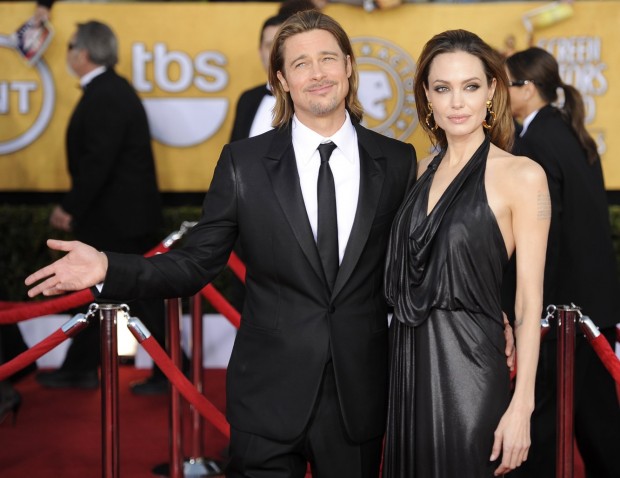
Brad Pitt, left, and Angelina Jolie arrive at the 18th Annual
Screen Actors Guild Awards on Sunday Jan. 29, 2012 in Los Angeles.
(AP Photo/Chris Pizzello)
The private phoner was prompted by work the congressman did for Jolie as she gathered information and sought interviews here with the Bosnian press and others. St. Louis has the largest population of Bosnians outside of their native country and Jolie wanted to let the community know what motivated her to make the film, "In the Land of Blood and Honey."
Carnahan is a co-founder of the the bipartisan Congressional Bosnian Caucus, and has hosted multiple briefings and traveled with local Bosnians to Bosnia. He is also a Congressional Delegate to the General Assembly fo the United Nations.
A spokeswoman for Carnahan said today that the film originally was scheduled for a limited release but that the high level of social media chatter emanating from St. Louis prompted the studio to bring it here.
The film will open today at 4:45 p.m. at Wehrenberg Theatre's Ronnies 20 Cine.
Interesting write up on Joli's new film #bloodandhoney tgr.ph/yPFQSo worth noting that in #Sarajevo she is something of a hero at mo
London
Angelina Jolie interview: I couldn’t allow my kids on set
Angelina Jolie’s first film as a director, In the Land of Blood and Honey, is a horrific tale set during the Bosnian conflict. She talks to John Hiscock about the emotional cost of making it .

7:00AM GMT 03 Feb 2012
Angelina Jolie’s first film as a director is definitely not for kids. She had
to ban her and Brad Pitt’s six children from the Budapest set of In the Land
of Blood and Honey whenever she was filming brutal and harrowing scenes,
which was much of the time.
But, whenever there was a break in filming, the children, aged between two and
10, were summoned to bring fun and laughter to the cast and crew and provide
a welcome respite from the grim and horrific acts being depicted for the
cameras.
“They liked to visit the set and play in the fake snow, but there were many
days when they couldn’t come because we were filming scenes that weren’t
appropriate for children,” she says. “But, whenever I called 'cut’ and we
had a break, the kids would come and play soccer with the cast, and we’d all
laugh because they brought levity and love to something that was so dark. I
was always so happy to see them I probably smothered them with love because
of the nature of the subject matter I was dealing with.”
The subject matter is a vivid and graphically explicit look at the fratricidal
Bosnian war of the 1990s, which pitted Bosnia, Serbia and Croatia against
each other along ethnic and religious lines, leaving an estimated 100,000
people dead, 50,000 women raped and introduced the term “ethnic cleansing”
to the lexicon of war.
The movie, filmed in 42 days for less than £10 million, was written by Jolie
who also produced as well as directed.
“I wanted to do this film because of what I’d witnessed in the past 10 years
in travelling to all parts of the world. And the more I started to read and
research about the former Yugoslavia, the more I was emotionally affected
and ashamed at myself for knowing so little about it.”
Apart from reading everything she could find, she also consulted Richard C Holbrooke, the architect of the Dayton accords that ended the conflict in December 1995 (who died in December 2010), Gen Wesley Clark, the Nato commander, as well as correspondents who covered the war and some of the victims and survivors.
Once she started writing, it took her a month to craft the story of Ajla, a Bosnian Muslim woman, and Danijel, a Serbian police officer, who meet in Sarajevo just before the war starts and are reunited when she is sent to one of the notorious “rape camps” where he is in charge.
Jolie decided to model her directing techniques on those of Clint Eastwood, who had directed her to an Oscar nomination in 2008’s Changeling.
“I had a great experience with him, and his sets are like family,” she says. “He works with good people. You have to be talented, but at heart you have to be a good person. There are no egos and everybody respects each other and works together. He’s so fast and economical, which I had to be because we had so very little money and had to move very fast.”
Her actors are from the former Yugoslavia, a mix of Serbs, Muslims and Croats, many of whom had lost family members or were wounded during the war. “It was a particularly hard film because I was asking people to recreate things they actually lived through and do brutal things to each other. As rough as we depicted the violence against women, it was really a thousand times worse.
“On the first day of filming, we shot a mass rape scene, and it was the first time these people from different sides of the conflict were in the same space and working together. I thought, 'This is either going to bring about great tension and we’re going to have a very difficult morning, or it’s going to do something else.’
“Right after I called 'cut’, the actor picked the actress up, gave her the biggest hug and brushed all the snow off her, and all the other officers picked up the women’s clothes and re-dressed them and apologised and brought them tea. By lunchtime, people were friendly and kind to each other, so there was a lot of love in the film. But there was a strong intention on my part to make it hard to watch because I wanted people to sit for two hours and be thinking, 'Please stop this, somebody intervene.’ We made it difficult to watch on purpose.”
In a bizarre convergence of Hollywood glamour and the horrors of war, we are talking in the comfort of a Beverly Hills hotel suite. She is well aware that her star status not only ensured the film could be made but is also the reason for the publicity it is generating and the discussion of the issues it raises, including rape as a war crime and the ethics of international intervention.
“How can there be such violence against women? How can the international community turn its back and allow these kind of atrocities?” she says. “There is no sane answer and it makes absolutely no sense.”
Her and Brad Pitt’s celebrity has helped in her role as a United Nations Goodwill Ambassador and brought attention to the humanitarian causes they support with both time and money. For the past decade, in between making movies, they have travelled the world, visiting refugee camps, building schools and hospitals and donating money where it is needed.
“Here in Hollywood, people get so stressed about things that are simply not the important things in life. So I am very grateful that years ago I was put in the middle of a conflict zone, where I came face to face with what is really happening in the world.
“I love being an actor, and I appreciate and have fun with all the blessings I’ve got from it, but it is a very small part of what is happening around the world. If I wasn’t somehow able to bring attention to issues when I go to other countries, it would weigh on me heavily. I have moments when I burst out crying and I don’t know why, and sometimes I can’t sleep at nights, but at least I can feel I can do something to be part of the solution.”
She is still basking in the positive reactions to a screening of In the Land of Blood and Honey, which she had just hosted in Sarajevo for representatives of war victims’ associations. Their original objections to her story of love between a Serb man and a Muslim woman had forced her to shoot most of the film in Hungary, with only some of the exterior scenes in Bosnia. But, she says, they were pleased with the finished product.
“Sensitivities are still running high, and I have a deep sympathy for people who were nervous, but I asked that people give us the chance to tell the story, and the actors would not have been a part of it if it wasn’t something that was right and correct.”
Jolie, 36, is keen to write and direct another movie and has already started working on a script about Afghanistan. “I loved the experience of directing, and I’d like to do it again. But I’m not yet confident that I’m good at it.”
Apart from reading everything she could find, she also consulted Richard C Holbrooke, the architect of the Dayton accords that ended the conflict in December 1995 (who died in December 2010), Gen Wesley Clark, the Nato commander, as well as correspondents who covered the war and some of the victims and survivors.
Once she started writing, it took her a month to craft the story of Ajla, a Bosnian Muslim woman, and Danijel, a Serbian police officer, who meet in Sarajevo just before the war starts and are reunited when she is sent to one of the notorious “rape camps” where he is in charge.
Jolie decided to model her directing techniques on those of Clint Eastwood, who had directed her to an Oscar nomination in 2008’s Changeling.
“I had a great experience with him, and his sets are like family,” she says. “He works with good people. You have to be talented, but at heart you have to be a good person. There are no egos and everybody respects each other and works together. He’s so fast and economical, which I had to be because we had so very little money and had to move very fast.”
Her actors are from the former Yugoslavia, a mix of Serbs, Muslims and Croats, many of whom had lost family members or were wounded during the war. “It was a particularly hard film because I was asking people to recreate things they actually lived through and do brutal things to each other. As rough as we depicted the violence against women, it was really a thousand times worse.
“On the first day of filming, we shot a mass rape scene, and it was the first time these people from different sides of the conflict were in the same space and working together. I thought, 'This is either going to bring about great tension and we’re going to have a very difficult morning, or it’s going to do something else.’
“Right after I called 'cut’, the actor picked the actress up, gave her the biggest hug and brushed all the snow off her, and all the other officers picked up the women’s clothes and re-dressed them and apologised and brought them tea. By lunchtime, people were friendly and kind to each other, so there was a lot of love in the film. But there was a strong intention on my part to make it hard to watch because I wanted people to sit for two hours and be thinking, 'Please stop this, somebody intervene.’ We made it difficult to watch on purpose.”
In a bizarre convergence of Hollywood glamour and the horrors of war, we are talking in the comfort of a Beverly Hills hotel suite. She is well aware that her star status not only ensured the film could be made but is also the reason for the publicity it is generating and the discussion of the issues it raises, including rape as a war crime and the ethics of international intervention.
“How can there be such violence against women? How can the international community turn its back and allow these kind of atrocities?” she says. “There is no sane answer and it makes absolutely no sense.”
Her and Brad Pitt’s celebrity has helped in her role as a United Nations Goodwill Ambassador and brought attention to the humanitarian causes they support with both time and money. For the past decade, in between making movies, they have travelled the world, visiting refugee camps, building schools and hospitals and donating money where it is needed.
“Here in Hollywood, people get so stressed about things that are simply not the important things in life. So I am very grateful that years ago I was put in the middle of a conflict zone, where I came face to face with what is really happening in the world.
“I love being an actor, and I appreciate and have fun with all the blessings I’ve got from it, but it is a very small part of what is happening around the world. If I wasn’t somehow able to bring attention to issues when I go to other countries, it would weigh on me heavily. I have moments when I burst out crying and I don’t know why, and sometimes I can’t sleep at nights, but at least I can feel I can do something to be part of the solution.”
She is still basking in the positive reactions to a screening of In the Land of Blood and Honey, which she had just hosted in Sarajevo for representatives of war victims’ associations. Their original objections to her story of love between a Serb man and a Muslim woman had forced her to shoot most of the film in Hungary, with only some of the exterior scenes in Bosnia. But, she says, they were pleased with the finished product.
“Sensitivities are still running high, and I have a deep sympathy for people who were nervous, but I asked that people give us the chance to tell the story, and the actors would not have been a part of it if it wasn’t something that was right and correct.”
Jolie, 36, is keen to write and direct another movie and has already started working on a script about Afghanistan. “I loved the experience of directing, and I’d like to do it again. But I’m not yet confident that I’m good at it.”
February 3, 2012 at 1:00 am
Review: Jolie pulls off dark reality of war and love
There's an inevitable darkness to Angelina Jolie's "In the Land of Blood and Honey," an unavoidable sense of despair and outrage.
This is, after all, a love story involving a Serbian officer in the early '90s and his Bosnian Muslim captive. Serbians are wantonly slaughtering Muslims, committing genocide with ruthless abandon, so a happy ending is going to be hard to come by.
"Blood" is Jolie's first venture as the writer-director of a feature and she comes at it straight on, neither pulling punches nor wallowing in excess. It's one of those man's-inhumanity-to-man movies, necessarily wearying and grim, but also well-made and thoughtful.
It's also pointedly pure with all the dialogue spoken in Serbian and an excellent cast of regional actors who are, obviously, mostly unknown to Americans. The language, the ravaged landscape, the physical tone of the actors, it all makes for a sure sense of reality.
The film begins with Ajla (the outstanding Zana Marjanovic) going to a nightclub where she meets Danijel (Goran Kostic), an off-duty police officer. Their flirtations come to a quick end when violence erupts.
Some time later, all the Muslim inhabitants of Ajla's apartment complex are dragged out of their homes. The men are taken off and shot. The women are driven to a prison where most are raped and beaten.
Danijel, it turns out, is in charge of the camp, and he provides protection for Ajla.
Eventually they bond despite awful circumstance. But they are a Muslim and a Serb, and trust is never easy.
The film's key twist seems a bit underdeveloped, but there's no avoiding the horror the film captures. Even in modern times, what monsters men can be.
tlong@detnews.com
(313) 222-8879


