Showing posts with label Collider. Show all posts

Monday, November 1, 2021


Salma "I did sign multiple movie deals. That doesn't mean they will put me in it."   Which means the earlier "scoop" that Angelina signed "a massive contract with Marvel and studio head Kevin Feige wants her to have a solo film as well" doesn't amount to anything.  The "multiple deals" is little more than an agreement to be available for future films.  She has already said she is not interested in a solo film without her eternals family.  "I loved being part of the family, so I have no desire to separate from the family. But I would be happy to play her again and explore even more deeply the struggles that she has. I think it’s fun thinking of where they’ve been over the years. We’ve got thousands of years worth of material. We can take her anywhere. I think that’s fun and I like the idea that we can pop up somewhere, maybe in other Marvel movies."


AMC Chloe


"I have experienced trauma,  And I have worried, been in a heavy place wondering if I am capable of all the things I need to be and do for those I love.  Which is her big struggle, not that she's feeling imbalanced, but can she protect those she loves, can she be of use to those she loves and do what's needed."


Toronto Sun

IVER HEATH, England — Just when you thought the Marvel Cinematic Universe couldn’t get any bigger, along comes Eternals .

It’s Day 82 of 82 of shooting on the long-awaited film, which is bringing to life some of the strongest and strangest heroes ever to appear in Marvel Comics, and Oscar-winning director Chloe Zhao is hard at work on a scene in which the god-like characters amaze a group of villagers with their otherworldly magic.

“It’s our most ambitious first film,” says Moore, whose credits include Captain America: The Winter Soldier , Captain America: Civil War , Black Panther and The Falcon and the Winter Soldier . Until the pandemic upended Marvel’s theatrical release schedule, Eternals was positioned to be the first new superhero film post Avengers: Endgame

“Because of that we wanted to take a big swing,” he says. “We wanted to take some chances and give audiences something that feels completely new.” First dreamed up by Jack Kirby in the 1970s, the god-like Eternals are alien beings that have been dispatched to Earth by the Celestials from the planet Olympia to defend humanity from the evil Deviants. After vanquishing their foes, the heroes have been quietly living among us for the past 7,000 years. So over the course of two-plus hours, audiences will be transported to Babylon, the Gupta Empire, the Aztec Empire and present-day London (among other places).

“There’s a past storyline and the present storyline … Like Godfather 2 ,” Moore explains.

“The Deviants go from planet to planet … and wipe out intelligent life,” he adds.

But after not having seen one of the murderous creatures for thousands of years, the Eternals are forced to reunite to protect humanity when the parasitic aliens re-emerge in modern-day Europe.

“This is our largest cast for a first movie, and the cast is pretty amazing,” Moore says.

Leading the group of heroes is Sersi (Gemma Chan), an ancient-artifacts specialist living in London whose unique power is her ability to transform matter with the touch of her hand, and Ikaris (Richard Madden), who can fly and shoot cosmic energy out his eyes.

Even though Sersi is dating a human (Dane Whitman, played by Game of Thrones’ Kit Harington), Eternals is very much a love story between her and Ikaris.

“We’ve made 25 movies now at Marvel, but this is the first movie that’s really built around a romance,” he says. “This, if we can do it right, is an epic romance.”

At first glance, Nomadland director Chloe Zhao didn’t seem like the right choice to helm an effects-laden Marvel blockbuster. But Moore says he and studio president Kevin Feige learned early on that her experience making intimate dramas could infuse Eternals with an emotional depth. “She pushed us,” Moore concedes. “She had a very strong vision of what the movie could be.”

Although the Eternals have been revived in the Marvel comics by Neil Gaiman ( Sandman ) and Kieron Gillen ( The Wicked + The Divine ), the characters we’ll see on screen will be drawn more from creator Jack Kirby’s original vision.

“We are actually inspired by the Kirby stuff,” Moore says. “The Gaiman run was very much about people who didn’t realize they were special with Ikaris coming along and saying, ‘Hey, guess what? You guys are immortal and your memories have been erased.’ That’s pretty cool, but that’s also the plot of Harry Potter and The Matrix , right?”

As far as Marvel is concerned, Thena is the “best warrior in the galaxy.” Still, with its ensemble cast, Angelina Jolie thought her appearance was just a bit part.

“She was sort of surprised at the size of the role,” Moore says. But the Oscar winner threw herself into the character when she realized it was something bigger.

“She created a movement style and fighting style that was unique.”

In the comics, Dane Whitman becomes a hero known as the Black Knight. We won’t see Harington suit up as the character in Eternals , but Moore says there could be big things ahead for Kit Harington in the MCU. “He’s not going to be Black Knight necessarily, but that is something that we get to play with down the road.”

Much ado was made when lovable schlub Nanjiani posted a “thirsty shirtless” photo of his completely ripped body to Instagram in late 2019. But it seems he took the whole working-out-to-be-a-superhero thing a little too far.

“We were like, ‘Hey, Kumail, don’t worry about it. This isn’t a movie where you have to work out a ton,’ ” Moore recalls. “But he wanted to do it … at some point I had to call him and say, ‘Kumail, I think you got too big.’ (Kingo) is a movie star, not a body-builder.”

Because this was from a set visit from 2 years ago, some of his other quotes seem dated.


Wednesday, September 18, 2019


Earlier this week, I got to sit down and talk with Brad Pitt about his new movie Ad Astra. In James Gray’s sci-fi film, which Pitt also produced through his production company Plan B, Pitt plays astronaut Roy McBride, who is tasked with trying to communicate with his missing father when his father’s work threatens all life on Earth. It’s a surprisingly emotional and somber picture with one of Pitt’s best performances as he portrays a stoic, reserved man coming to grips with his past and his weaknesses.


"We set out to make a very sincere film, a real bare bones, bare, raw honesty.  The danger in that, in sincerity is it can become to earnest and tip the scales of the film. "

"You get older and you just get tired of protecting yourself or having any secrets.   You want to get on with it and we wanted to get on with it in this film in a way.  We all carry great pains, great regrets. We've all experienced loss, we've all experienced great loneliness at times.  And we're good at packing that away and not dealing with it.   Some of us are good at getting through it and coming out the other side with a more well-rounded, a more confident and loving human being.  We just wanted, no holds barred, let's just go, let's get it out there."

"My individual experience is somewhat universal, in the fact that you know our parents, our universe, our gods, our first imprint on on how to behave, react, feel in the world. And with that, to different degrees, some of us more than others, carry pain and confusion from that. I think it almost takes a lifetime to understand what was yours, and what was theirs.  As a child we take fault or something of that nature on ourselves.  It was just a real investigation of parsing through that and being able to understand yourself.  "
"My dad always said he wanted to give me a better life than he had coming from extreme poverty, and he did it. And it makes me think, as a dad, what do I have to offer that's better than I had, to my kids?"

What about women? It's interesting that,hahaha (Brad makes a face) that the 2 female characters are pretty minor characters, minimal appearances on screen and some people have remarked on that.  Tell me the reason for that and the thinking behind that.
"I'm not sure what the remarks are.  This is an investigation of masculinity and our definitions of a Marlboro man-type, never show weakness or vulnerability.  Liv Tyler's character represents his regrets, what he got wrong, what he feels he mishandled or he missed.  And she is in the feminine an example of what we in the masculine need to take better note of.  Ruth Negga's character is a voice of wisdom that sends us in the ultimate direction of death and rebirth.

Publicly you spoke of what it's like to go through one of these things that not many men talk about, many men don't think it's OK to get help for certain things like alcohol and other kinds of substance.  You spoke without revealing the confidential nature of Alcoholics Anonymous about what it did, what it gave to you.  Can you tell me so that other people who are in that situation might get a boost from somebody like you if they need that kind of help.
"I don't know, for me what I realized is that I was running to things to avoid tough feelings, painful feelings.  I just didn't know how to deal with them. Anything I found that I used for escape.  Those kinds of difficult feelings, I don't know how better to describe it. It can be anything, drugs, booze, Netflix, snacks. Anything. I don't want at this point to be running from anything.  I want to sit in it, I want to feel it, I want to get through the rough night. I found in doing so, you come out the other side with a more profound understanding, of yourself and a greater gratefulness for those in your life. And the birds and the trees and everything else."

"At that moment, I was just a boy from the Ozarks on the playground.. and that's.. and that's how we confronted with things."
"I just wanted to make sure nothing was going to happen further, because she (Paltrow) was going to do two films. I think the interesting thing is that we, Hollywood specifically, but the workplace, men and women's dynamics is being recalibrated, recalibrated in a very good way that is long overdue. And I do think that's an important story to tell."


VENICE, Italy (AP) — Brad Pitt made the first move with James Gray.

In 1995, he saw Gray’s debut “Little Odessa” and decided to call up the young filmmaker behind the grim Brooklyn crime drama. They’ve been talking ever since — about films, life and working together. But it would take almost 25 years for the stars to finally align, fittingly, for an ambitious, original space odyssey called “Ad Astra” that opens in theaters nationwide Friday.

“It’s a gutsy film,” Pitt said last month. The 55-year-old both produced and stars in the story about an astronaut who ventures almost entirely alone into the outer reaches of space to investigate a disturbance that may be tied to his missing father. It’s something Gray had been working on for years.

Pitt’s choice of the word “gutsy” is appropriate, not just as a description of the film and its exploration of big themes like masculinity with the grand canvas of space as its backdrop, but in talking about the fact that it exists at all. Not many studios and production companies are handing over $80 million for original ideas anymore. That Pitt’s Plan B, New Regency and 20th Century Fox banded together to make “Ad Astra” happen is, Gray said, “Beyond rare...It’s a big risk.”

Pitt, sitting next to his director, chimed in: “It’s why studios have veered away from them. They’re a big gamble: The cost, the prints and advertising. It’s why they have to take safer bets.”

The business has changed so much that Gray doubts that “Ad Astra” would even be made today. But three years ago the two decided to take a leap on this big idea to make an epic set in the near future that Gray likes to call “science-fact-fiction.” Gray was fascinated by the type of personality that’s required for space travel and that Neil Armstrong, upon returning to Earth from the Apollo 11 mission talked only about the logistics and facts — nothing metaphysical or contemplative.

Deflection,” Pitt said. “I do it all the time.”

Not that Pitt isn’t introspective about his work. He said he was drawn to the idea of the “dark night of the soul. When one is really forced to address their self and the things we carry and most likely bury, congenital griefs, regrets, those personal pains and to come out the other side, hopefully, embracing those is the way to becoming whole.”

“It was something on my mind as well,” Pitt said.

And his performance is a standout that critics and awards observers have taken note of, on top of his acclaimed work earlier this summer in Quentin Tarantino’s “Once Upon a Time in Hollywood.”

“He is a fabulous actor,” Gray said. “And there aren’t that many fabulous actors with mucho charisma in the world.”

Pitt disagrees with his friend, but he is happy to keep working.

“I so believe in being creative and want to be creative till it’s all said and done, until someone pulls the plug on me,” Pitt said.

Part of that involves throwing his production company’s weight behind ambitious, original projects, some of which work out and go on to win Oscars and steer the cultural conversation (“12 Years a Slave,” ″Moonlight”), and some that don’t. Plan B produced Gray’s last film, “The Lost City of Z,” a period adventure film about explorer Percy Fawcett, which never played on more than 1,000 theaters, nor made back its $30 million production budget.

“Ad Astra” has already seen a bit of turbulence before its release. It was one the Fox films that is now being released by Disney after it acquired the rival studio, causing “Ad Astra’s” release date to shift a few times.

“It’s like worrying about the alignment of the planets. It’s so past your pay grade,” said Gray, who was finishing the film when the deal was happening. “Was I worried? No, because I can’t do anything about it. I just thought, ‘Well that’s weird.’ But I will say in one small respect I disagree with Brad on this. I do think that one company controlling 40% of the theatrical market in the world is a dangerous proposition. That’s almost a monopoly. So to the degree that means fewer films, fewer, fewer chances to make this kind of film, that’s a source of some concern.”

Pitt has also been asking big questions like if “film as an art form is going to last” when the two start riffing about whether they have the same staying power today.

“If I say to you ‘I’m gonna make him an offer he can’t refuse,’ you know what I just did, right?” Gray asked. “Can you quote me a line from ‘Avatar?’”

Pitt’s response? He loves “Avatar.”

But Gray has a bigger argument: “It’s visually spectacular, but it’s a different form of the medium. And if we lose ‘I’m gonna make him an offer he can’t refuse,’ then we lose something big.”

By this point, Pitt had wandered over to the massive window in the room and was snapping photos of the beach and water outside when he started to laugh to himself. He said he was thinking about the lasting quotes that have come from his own career and spit-balled a few, like “What’s in the box?” from “Seven,” and “Don’t condescend me, man,” from “True Romance.”

Nothing, he concluded, had the weight of Marlon Brando’s line from “The Godfather.”

“Well you know what Francois Truffaut said,” Gray asked. “He said cinema has to be part truth, part spectacle.”

Pitt paused and thought about it: “Now we either have all spectacle or all truth.”

The hope is that “Ad Astra” is a bit of both.


Wednesday, December 21, 2011

Collider RT transcript

NOTE;  This is the exact same Roundtable interview that Jeff Wells participated in and that he posted earlier.  Collider provides another transcript from that session. 

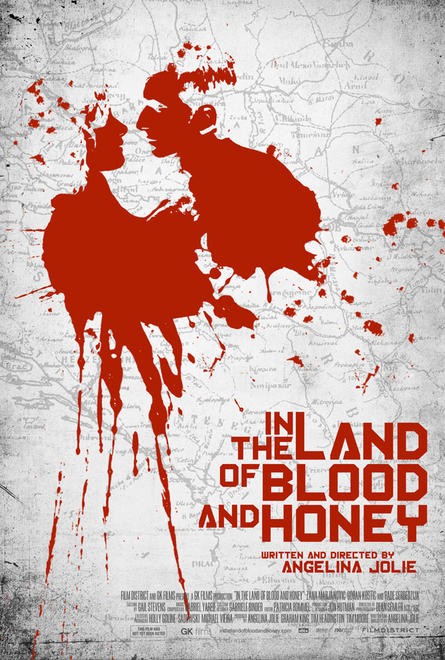
Angelina Jolie IN THE LAND OF BLOOD AND HONEY Interview

by Christina Radish    Posted:December 19th, 2011 at 6:10 pm


Set against the backdrop of the Bosnian War in the 1990′s, In the Land of Blood and Honey tells the story of Danijel (Goran Kostic) and Ajla (Zana Marjanovic), who are on very different sides of the brutal ethnic conflict. As that conflict takes hold of their lives and their relationship changes, their connection to one another becomes strained and their allegiances grow uncertain. Portraying the incredible emotional and physical toll that the war takes on individuals, the unrelenting brutality is intended to make audiences question why it took so long for anyone to intervene in a society plagued by such horrific acts.
At the film’s press day, Angelina Jolie talked about making her writing and directorial debut with this war drama, what led her to tell this particular story, cutting the film down from the initial four-and-a-half-hour version that was way more brutal, deciding to shoot the film in two different languages (Bosnian and English), that writing is a cathartic process for her, and that this experience taught her how much she loves being on the other side of the camera. She also talked about a script she’s written about Afghanistan, but said that she doesn’t know if it’s any good, or if she’ll ever show it to anybody. Check out what she had to say after the jump:
In-the-Land-of-Blood-and-Honey-Angelina-Jolie-1.jpg

Question: With all of your world travels, you see so much more than the rest of us see. What led you to this particular story?
ANGELINA JOLIE: We wanted to make a film that’s universal and that could be anywhere, but I landed on Bosnia because I remembered it. It was my generation. I was 17. I remember where I was in the ‘90s, and I felt a guilt and responsibility for not knowing enough and not doing enough. I thought, “This is something I should know more about. This happened in Europe, at this time. Why do I not know more about this?” And, the more I researched, the more compelled I was to make it, and the more I felt we really haven’t discussed it enough. We really don’t quite understand it. It’s only 15 years later and they are still healing from this process. These countries are still forming, and things are still changing in the region. With post-conflict situations, when the conflict is over, a few NGO’s stay, but the attention goes everywhere else so quickly that proper healing is not done. You need proper care to really help people through and out the other end of a situation like this. There was so much trauma with this, and people were so divided, it’s still very, very hard for people in the region, today.


Since you never had any intentions on making a film, were you surprised to actually produce and direct one of your scripts?

JOLIE: Oh, it’s completely bizarre. It’s all very bizarre. I still find it very strange. I don’t know how I got here. I didn’t attend to do this, really.


Why did you decide to make this film so hard to watch for audiences?

In-the-Land-of-Blood-and-Honey-Goran-Kostic-Rade-Serbedzija 

JOLIE: In order to get this message out, of wanting people to pay attention and wanting for timely intervention, and not just boots on the ground, but some kind of intervention and dialogue, and if we could make people feel that, in a visceral way while they’re watching it, and if they’re angry help is not coming, then that would be the conclusion that they would walk away with. We tried to make a traditional film with characters and good acting, but somehow you just can’t soften this kind of war. The reality is that the four-and-a-half-hour cut was a lot worse. Some of the hardest things were actually cut out because some people just really could not handle it. I personally feel like, if you’re watching a film about war, you should get a sense of what it’s really like, so we tried to make it authentic.

What was the process of writing your first screenplay and making your directorial debut? Where did you draw some of your inspiration from? Was it from other filmmakers you’ve worked with, in the past?
JOLIE: I did. You know, this was an unusual one because I didn’t set out to become a director. It wasn’t “I want to direct something, so I’m going to write something.” I wrote it because I wanted to think about these issues. I’d written journals and op-eds, and this was just an experiment for me. I wanted to give myself this homework to have the excuse to do it. And then, the cast came together and things started to happen, and somehow it became real. I couldn’t let it go, and I ended up directing. But, because I’m not from the region, in many ways, they directed me. I can’t direct Vanesa [Glodjo] and tell her how to run across sniper alley. She was there, so she can tell me. So often, I was the one asking them, “Does this look right? Did we get this right? Does that sound right? Tell me about when your neighbor’s baby died. How did she react? What happened? Can you give me more detail on that?”

In-the-Land-of-Blood-and-Honey-Goran-Kostic-Zana-Marjanovic 

So, it was a very different situation, for all of us. Of course, I pulled on things I learned. I’ve had such amazing directors, in the past. Clint [Eastwood] has taught me about having a crew of good people that you respect, and everybody treats each other well and there’s no drama. He’s a great leader, in that way, so I tried to create a family. Everybody was just good people. When we were putting the team together, we wouldn’t say, “Who’s the most talented?” We’d say, He’s talented, but is he a nice person?” This is a really hard subject matter, and we didn’t want people on set who aren’t nice people. We wanted a family. And, from Michael Winterbottom, I learned a lot about knowing which scenes to really help the actors, so they could live it completely, and not chop it up and not get in their way.

Can you talk about the decision to shoot the film in two different languages and the challenges of that, as a director?
JOLIE: Well, I wrote it in English because I had to. And then, when we had it translated, we had it translated by different people from different sides, to make sure the translation was fair and balanced, which you have to do with almost everything in this region. We talked together with the cast because they all speak English very well, and those who didn’t, learned their scenes phonetically. We felt that the reason for making this film wasn’t just for the people of the area, and we wanted it to be authentic. And yet, we know that there are a lot of people out there that we want to learn about this part of history and speak about these themes, but those people often don’t go to foreign films. So, we said, “Could we do this?” For us, it was not about making a movie. It was about getting a message out and wanting to get it to as broad an audience as possible. In certain states, a theater will say, “Foreign films don’t work. I’m not buying a foreign film.” But we can say, “Okay, we have another version. Can you take that?” I think France immediately wanted the authentic language. There was a question with America. It was up in the air. I think the UK has bought the English version. Maybe they’ll change their minds when they think about it for awhile. I don’t know. People seem to be shifting. They’re not sure.
In-the-Land-of-Blood-and-Honey-Goran-Kostic

Will the DVD have both?
JOLIE: Yeah. I would love that for the actors. I wish I could shout from the rooftops, how talented these people are and how gifted they are, because I really would love them to cross over into this town and get jobs and work. I don’t know if people understand the extent of how hard their jobs were, but when you see the scenes back-to-back, you understand what they accomplished. I just have so much respect for them. I would like people to see it, if just for that.

Your use of the handheld camera really makes the film personal. What made you decide to do that?
JOLIE: Well, part of it was that we had no time. It takes a long time to set up a dolly track. For example, the end scene between Ajla and Danijel was very much aggressively over one shoulder on the other. My D.P. told me something when we first started. He said, “You never split your lovers. You never separate them. You always try to keep your lovers connected in a shot.” So, we had that in mind. We also wanted to make it feel like a big film, even though we didn’t have a lot of money, and we knew that we wanted it to feel real, and reality is not so staged. Many things had to be broken up in this way. You had to be inside with everyone. You had to inside with the women who are the human shields, so that the audience would feel that.

In regard to your process as a director, the actors said that you are very well-prepared, very fast, and that know what you want. Can you talk about working with the actors?
JOLIE: It was very fast. We had 41 days and $12 million, and we had three and a half years of war and many different seasons to re-create. I found out how much snow cost. I’d say, “I want to snow this whole area of Yugoslavia,” and they would say, “Okay well that is $100,000 worth of snow.” I would say, “Okay, so what’s $20,000 worth of snow?” Plus, we shot in two languages, so everything is doubled. Suddenly, the already tight schedule was tighter. We had to select scenes that had to go. We had to cut the script as we went, and we had to condense things. But, I do like working like that. I like being busy. I have a lot of respect for crew and actors, so I’m happy that they felt I was professional and prepared because I try to be.
In-the-Land-of-Blood-and-Honey-Angelina-Jolie-Dean-Semler

Does the crew look at you differently, when you’re the director, as opposed to when you’re the lead actress?
JOLIE: Yeah, I suppose they do. You can set a tone. I guess you’d have to ask the crew, but I wasn’t the center of attention. Zana [Marjanovic] was the center of attention. I was the buddy in the corner with all the paperwork and the pencil in her ear, and it was lovely.

In the film, you do a great job of showing different takes on the situation, between the Bosnians and the Serbs, and it brings to light a little bit about how little the rest of the world did, in regard to this situation. Can you talk about bringing light to that and how audiences should feel about that?
JOLIE: I didn’t intentionally make people feel guilty, but I have had that response from a lot of people – that they feel guilty that they didn’t do enough. I feel guilty. I didn’t know enough. So, I think we all should feel that way about this particular war, and we should wonder what it is that we’re going to look back on, in 15 years, and feel that we also didn’t do, that’s happening today. It’s extraordinary. It’s so strange. What were we doing?

Has Bill Clinton seen this?
JOLIE: He has a screener. I don’t know if he’s watched it yet.
In-the-Land-of-Blood-and-Honey-Angelina-Jolie

He’s made it pretty clear that he feels that was probably the biggest mistake he made.
JOLIE: Well, Rwanda and that. There were a few. I like President Clinton. I talked to him about it. I called him to say that we did this film on it, and he just said he was looking forward to seeing it and he was very happy that somebody did something on this subject matter, and felt that it was very important that people didn’t forget that time in history and those people. He told me a little bit about the complexities of the years when he said he was going to do something and when he finally did, and what happens to a president, during that time, and what needs to be done. It’s interesting. I’m curious for when he sees it, and if he’s willing to talk about it, which I’m sure he will be, when we talk about Bosnia. I’d be happy for him to join this discussion and help us to understand what took so long.

When you were on set, did you ever find the need to call a time out, much like you would with your children, at home?
JOLIE: There were certainly moments that people had to step outside for a little bit and cry because something became too real and we just needed to take a pause, or we needed to sit together and talk about, “What does this mean? What is this saying? Are we doing the right thing?” We were always asking ourselves that. You’re trying to find this balance, which is an impossible balance to find, really, in this region. You’re doing your best to present something that’s not a documentary or a political statement, but it has all these politics and it has all this sensitivity, so you’re walking a very fine line. So, we were always talking about this line and whether we crossed it. But, the opposite actually happened with us. Because it was so violent and because there were so many aggressive scenes against each other, in between takes, everybody was so kind to each other. Everybody looked after each other. Everybody was running to get each other something to eat or a jacket. They really looked after each other because they didn’t want to hurt each other. They were forced to recreate this, and then they felt bad.
In-the-Land-of-Blood-and-Honey-Angelina-Jolie-Dean-Semler-1

Is directing a lot like being a mother?
JOLIE: Well, there’s constantly people asking you for something, so the multi-tasking of motherhood transfers very well to being a director. And, I think you’re compassionate. I get nervous. I see people get dressed up for a premiere and I think, “Oh, did she get the right earrings?” Or I think, “Did he get anything to eat, before he went to the interview?” With all these other adults, you still feel this strange, nurturing, mothering quality for everybody.

Goran Kostic said that he felt it was important that a female writer/director was telling this story and giving that perspective. Did he express that to you, at all? How do you feel about the importance of having that point of view for this?

JOLIE: In many ways, it’s the point of view of a woman and it deals with the sexual violence against women. Not that a man couldn’t make that, but the internal struggles that a woman goes through and a woman’s point of view maybe makes it a little different. But, so much of my focus was also trying to understand the men. I was trying to put myself in the men’s shoes, which was the biggest challenge for me. I had to write for Nebojsa (Rade Serbedzija). I had to write for Danijel (Goran Kostic). I had to be this other thing, and then direct them. So, in my mind, it was both. But, at the heart of it is my heart, and my heart is very similar to Lejla (Vanesa Glodjo). The loss of a child is my greatest nightmare. The question of whether or not I could turn against somebody I love and what that would take would be the relationship that I would relate to. But, especially the focus on the violence against women and the way the sexuality is handled, women together could discuss how far we could go and what we thought was appropriate, and we also knew what we didn’t feel safe with and how we would protect each other. So, we had this trust, as women together, to deal with the sexuality and violence together.
In-the-Land-of-Blood-and-Honey-Zana-Marjanovic-Boris-Ler

There are some horrible atrocities depicted in this film, with rape, ethnic cleansing and the death of an infant. Was it difficult to re-enact and create those scenes, and to be there and see those moments?
JOLIE: The difficulty was that I met [people who had been through those things]. For example, the human shield scene was based on a story that a woman told me, one day. We talked and she walked me through the entire thing that happened to her. So is the scene with the women having to strip and dance naked in front of the soldiers while they laughed at them, in front of everybody. So, learning about that and then re-creating it, knowing it was real, was very hard, but nothing was ever as hard for me as it was for the actors who were there. The dinner scene, where everybody was eating the food, all of those actors were effected by the war, but one was able to get out. Everybody else lived off those exact food rations for three and a half years. So, when the food rations came out, they were very emotional. They were so cute too because they looked at some things and said, “We didn’t have chocolate peanut butter. They have tabasco sauce.” It was so moving, but they also had to sit down and think about it. Some of them can’t eat peanut butter anymore because they ate it for three years, so the taste of it makes them remember. It’s crazy. But, everything was sensitive to them. 

Since you do so much humanitarian work around the world and you see so much atrocity, is that what inspires you to write? Is the writing process a cathartic experience, based on your need to express what you’ve seen?


in-the-land-of-blood-and-honey-poster 

JOLIE: It is. I’ve also written a story about my mother, after she passed. They are things that I will never show anybody, but it is nice to spend time with people and characters, in this private world. Then, with the ones that have to do with history, it’s a great excuse to have to learn more. You start to focus your news and what you’re reading about. You’re pushed to get a better education, in different things.

What’s the greatest thing you’ve learned about yourself, during this directing process?
JOLIE: That I loved being on the other side of the camera. I loved watching another actress in the spotlight, do an extraordinary job, and I loved making her beautiful and interesting, protecting her emotions, and showing people her talent. I loved being on the other side of the camera and interacting with the crew. When you are an actor, you have to stay inside this world, but when you are with the crew, on the outside, you are in the dirt, working through all the issues. It’s just a different way of working, and I think I preferred it. 

What is the script about Afghanistan that you told producer Graham King you want to do?

JOLIE: Between Graham and me, it was an idea. I said that I had this thing, but nobody has seen it. It’s just something that I have on my desk, but now it’s something that I’m talking about. No one has actually seen it, and I have no idea if it is any good. I traveled to Pakistan for two weeks, before September 11th, and I visited Afghan people, when they first landed in Kabul. Over the last 10 years, I’ve tracked some families and been with them. On the other side of it, I’ve visited a lot of wounded soldiers in Ramstein and Walter Reed, and met with a lot of female soldiers. What bothers me is when they say that women are not in combat, and yet they are dying in combat. It is this lack of respect for female soldiers and what they go through, and the new relationship between men and women, when the women go to war, and what it is for a woman to leave her children when she goes to war. It was a study in that. That is where it came from. I don’t know if I’ll ever show it to anybody, but that was what it was.

IN THE LAND OF BLOOD AND HONEY opens in theaters on December 23rd.

Tuesday, December 20, 2011

Collider talks to Goran and Zana

Goran Kostic and Zana Marjanovic IN THE LAND OF BLOOD AND HONEY Interview

by Christina Radish    Posted:December 20th, 2011 at 5:45 pm


untitled_angelina_jolie_film_movie_image_slice_01
In the war drama In the Land of Blood and Honey, which marks the writing and directorial debut of Angelina Jolie, Danijel (Goran Kostic) is a Bosnian Serb police officer and Ajla (Zana Marjanovic) is a Bosnian Muslim artist. Together before the Bosnian War that tore the Balkan region apart in the 1990′s, their relationship quickly changes, as violence engulfs the country. When Ajla is taken from the apartment that she shares with her sister, Lejla (Vanesa Glodjo) and Lejla’s infant child, she comes face-to-face with Danijel and his troops, under the command of Danijel’s father, General Nebojsa Vukojevish (Rade Serbedzija). As the conflict takes hold, their connection to one another grows uncertain, and the war takes a physical and emotional toll that neither of them will ever recover from.
At the film’s press day, co-stars Goran Kostic and Zana Marjanovic talked about revisiting this war for the experience of making the film, the difficulty of getting through some of the more emotionally intense scenes, the experience of shooting in both Bosnian and English, and the importance of having somebody like Angelina Jolie bring this particular chapter of history to the world’s attention. Check out what they had to say after the jump:


In-the-Land-of-Blood-and-Honey-Zana-Marjanovic-5

Question: Zana, was this a cathartic experience for you, revisiting this war?
ZANA MARJANOVIC: It was, in a way, especially the very beginning of the film. That’s my childhood and that’s what I remember, and that’s the period of my life where everything was perfect and happy and lovely. My parents were happy, and we had a home and friends. It’s where I come from, and that’s how I remember it. All of that was taken away from us, in just one night. With the first shotgun, everything changed. I had to grow up fast and realize what was happening. So, that innocence was lost for me. Revisiting it was very difficult, for me, personally. As an actress, of course, there were other scenes that were very demanding.

Goran, how did your lineage impact your performance in this film?
GORAN KOSTIC: My father is an army officer in the Serbian army, but that’s where the similarities end. His record is clean and he’s retired. At the same time, coming from Sarajevo in Bosnia and being there for the first 20 years of my life, and having a father that was a very dominant, strong figure in our family, it was easy to tap into that experience from the first 20 years of my life and transfer some of that emotional landscape to my performance of Danijel. My concern was the fact that we get to see him pure and light, and then we see him as something completely different. It was easy to jump from one box to another. What was more difficult was to show the different colors that Danijel goes through, from white to black. That was my greatest concern. I did my best, and Angelina [Jolie] was really good about it. The rest of the cast helped each other, to come up with a believable character. 

Zana, how did you go about developing the sister relationship with Vanesa Glodjo?

MARJANOVIC: She kept touching me and hugging me. I don’t have siblings. I’m not that person. The intimacy thing is just too far for me. The whole borrowing clothes thing is very unnatural for me. I don’t feel comfortable with that. If you like something, I’d just give it to you rather than sharing it. When we started working, Vanesa brought up a very good point when she said, “We don’t have that much time where we represent them as happy sisters, living a normal life. We have to use that time to really feel the bond between the two.” It’s so important for later. It’s one of the biggest motivations for what happens.
In-the-Land-of-Blood-and-Honey-Goran-Kostic-Rade-Serbedzija

Goran, what was it like to work with Rade Serbedzija, as your father?
KOSTIC: I knew of Rade for a long time, but we’d never worked together. When we met, it literally took three minutes for me to realize that that guy really is like my dad, and Angelina believed it. In the scene where Danijel gets slapped a few times by his dad, we were not really pretending or acting. It was a proper hand touch. I knew that the first take, it was going to be light, the second time was going to be stronger, the third time was going to be even stronger and, by the fourth time, he was going to give me a proper one. I knew that we should not go over four takes. And then, in the fourth one, he just slapped me, full-on, and the reaction was pure. Angelina ran over and was worried, and I said, “Don’t worry, girl. This is how we do it back home.”

How difficult was it for you to actually get through some of the more emotional scenes?
MARJANOVIC: Yes, of course, it was very difficult, but I tried not to think about it, in that way, because whenever I felt that I wouldn’t be able to handle it all, or that I wouldn’t be strong enough, I would just think that I’m only acting it and people have gone through it, and there’s no place for me to be spoiled and say, “This is too hard.”

Goran and Zana, you have some very emotionally powerful and physically violent scenes together. How did you and he develop a chemistry and prepare for that?
In-the-Land-of-Blood-and-Honey-Goran-Kostic-Zana-Marjanovic 

MARJANOVIC: Well, we always rehearsed. If we had a chance, we would rehearse the day before with Angelina, and then we would have our little theater. The three of us would rehearse, and then we would invite the crew, and they would stand and watch the scene and know how to prepare it, while we just sat and talked about it, during that time. That was one way. I just had to stay away from him. I’m a rational person, and I’m not a method actor. You don’t need to call me by my character’s name while I’m not shooting. But, it does affect you. Of course, it does. You’re very vulnerable and you’re very fragile, and that is where Angelina was such a big support and guidance. She knew exactly what we were going through, as actors, and knew the right thing to say, or sometimes knew that she shouldn’t say anything. Goran is such a gentleman and such a wonderful actor. I remember the first day, we shot one of the most difficult scenes, in the concentration camp when the women were just getting off the bus, and he had to hold me over the table. He was a meter away from me, and we kept repeating the take. I said, “Are you going to get closer?,” and he said, “Oh, can I?” I said, “Yes, you needed to.” He said, “I just needed you to tell me that it’s okay.” He really couldn’t do it, until I said, “Go for it.” That made me feel very comfortable because I knew he’d watch out for me.


Did that trust make it any easier to have him strap you to a bed?
In-the-Land-of-Blood-and-Honey-Zana-Marjanovic-Boris-Ler 

MARJANOVIC: That was a hard day. He made sure, before and after each take, that I was fine and that I had everything, and he kept apologizing. It was very emotional, in many ways.

Do you think that, under these circumstances, Ajla had love for Danijel?
MARJANOVIC: Under these circumstances, I don’t think there could have been love. Before the war, at the beginning of the film, she was in love, but she wasn’t in love with her enemy. She was in love with a guy who was a cop and who she had a few dates with. And then, that guy becomes her enemy and she tries to survive. It’s very simple. You fall in love with someone and, as you’re falling in love, someone tells you that it can’t happen because you’re on different sides, whether it’s race, religion or ethnic background. They’re divided by the conflict. It’s about how that love is destroyed. It’s about the love that never really developed fully because they didn’t have time. It’s about the love that could have been, but didn’t happen. He is a soldier and she is a prisoner in the camp. For me, it’s very emotional.

How important is it to see somebody like Angelina Jolie showcase this particular chapter of your homeland and bring it to the world’s attention?
KOSTIC: To me, it was important that it was a female voice and a female director, as opposed to a male director. Also, what I’m really grateful to Angelina for is the intensity and seriousness with which she embraced the story. She spent a huge amount of energy on it, trying to understand and learn about it. She was very smart about it, and gave us time and space to give our input into what was being said. I’m grateful, in all those ways. She approached the subject matter with a great tenacity and a great cautiousness, while at the same time, giving us, who are people from the region, the space and time we needed.
In-the-Land-of-Blood-and-Honey-Angelina-Jolie-Dean-Semler

What was Angelina Jolie’s process, as a director? How was she to work with, on the set?
MARJANOVIC: What I really appreciated, and it’s also something that was already clear, just reading the script, is that she knows exactly what she’s doing. She gave the victims the strength they actually had, which is why they’re survivors. Bosnians, as people, are not only victims. We’re actually survivors. And, it’s so important to know that. The most amazing thing in Angelina’s film is that she went through this intimate, personal perspective and, through that, she really engaged the audience to watch the film as if it could be them. It’s not some people, somewhere, at the end of Europe, that’s maybe not even Europe, and they’re Muslim. She gave Bosnians dignity, and I really appreciate that.


KOSTIC: She glides between the problems. She never does it abruptly. I’m sure she’s processing, but when it comes to her expressing herself, she’s always very nice, structured and thoughtful. She truly is a lady, in every meaning of that word. Even when she directs, she does it with such a gentleness, which puts you in a good place, as an actor. That relaxes you. Often, when you start filming, people say, “I’m going to take care of your ideas,” but those are just words. With Angelina, the process is truly about incorporation, learning, and giving space and time to one another. The environment that she creates, you forget that she’s there. At the same time, at the end of the day, she would draw the line and say, “This is my decision,” and do what she had to do.
in-the-land-of-blood-and-honey-poster

So, she didn’t feel like a first-time director, at all?

MARJANOVIC: No. Maybe she did a film before, secretly somewhere. It’s really unbelievable. It’s all the experience she has, for so many years. She’s such a fantastic actress, and she keeps doing it. In the first week of shooting, we had the two languages and it was low-budget already, and they said, “We’re going to try to do it, but if we run behind the schedule, we’re going to have to just stick with one.” So, they asked us just to have the concentration to do it because it would be really nice to have it in both languages. But, within the first week, doing two languages, we actually saved a day and we were ahead of schedule. 

What was it like to also shoot this film in English?

MARJANOVIC: For me, I grew up in New York, so I’m fine with both versions. But, what I was amazed at was the other actors. I had no idea they spoke English so well, and act in both languages. I really believe their performances are exactly the same. It really helped, doing it in both languages. I’m a different person, in each language. Since the character comes from Bosnia, whatever language we chose to play it in, it had to have the root of the language and the dynamic and the gestures. It was very helpful to me.
KOSTIC: The English version was longer than the Croatian version, but everything was being said. There’s the technical problem of where the length is. 

Do you know what happened to the war criminals?
MARJANOVIC: It’s because of the strength and how courageous these women were, that went through horrible things during the war, and their testimonies that a lot of these war criminals were prosecuted and convicted, eventually. On the other hand, you hear stories of people, because of how Bosnia is divided, where a Muslim woman goes back to her land and it brings up memories and she sees the person who did her wrong. 

IN THE LAND OF BLOOD AND HONEY opens in theaters on December 23rd

Monday, May 16, 2011

Maleficent - Open Directing Post

This is good news as far as I'm concerned as his Alice in Wonderland was visually stunning but lifeless. David Yates acquitted himself well enough with the HP series but I would like to see Guillermo del Toro take over. His Pain's Labyrinth was a far better movie than Alice and Jennifer Yuh Nelson raved about his contributions as a consultant to Kung Fu Panda 2.

Tim Burton Won't Direct Disney's 'Maleficent' (Exclusive)

The project would have teamed the "Alice in Wonderland" director with Angelina Jolie.

Tim Burton has moved off of Maleficent, the Disney fantasy that would have teamed him with Angelina Jolie.

Maleficent is Disney’s live-action take on Sleeping Beauty, telling the fairy tale from the point of view of the evil witch who threatened to kill the princess. Disney put a name to the evil witch, who had gone unnamed in the various tellings, and the green-skinned queen of evil who morphs into a dragon has gone on to become one of the most popular Disney villains all time.

Burton was only loosely attached to the project, but his involvement was significant enough that last year the studio hired Burton's Alice in Wonderland collaborator Linda Woolverton, who also wrote Disney’s The Lion King, to write the script. The project is being developed as a starring vehicle for Jolie.

Disney is not about to go put Maleficent into a suspended-animation sleep and is now on the hunt for a new director. One of the names that has surfaced in the early search is David Yates, the director of the past four Harry Potter movies.

Burton hasn’t left Disney and is working on the feature-length stop-motion version of his 1984 short, Frankenweenie. The movie is due for release in Oct. 5, 2012.

Reactions

Collider

by Brendan Bettinger

Burton is a frequently great director, and Maleficent has a striking premise, but this split is surely for the best. The headache of my Alice in Wonderland viewing never fully subsided, and another megabudget Burton movie with dragons and wicked women and Gothic set design (presumably) sounds like a vicious migraine in the making.

Warner Bros. wants Yates for their Al Capone biopic Cicero. But if his schedule permits, or Disney can lure him away from the Harry Potter studio, Yates is a great choice for the subject matter and scope of the project. Good luck, Mickey.

Total Film

By Josh Winning | May 17th 2011

Burton’s departure from the film appears to be an amicable one, with his Alice In Wonderland scriptwriter Linda Woolverton still attached to scribe Maleficent’s script.

Meanwhile, Burton is still pressing ahead on his Frankenweenie feature over at the Mouse House.

Disney are apparently now interested in contracting Harry Potter director David Yates to take on Maleficent. Which could prove difficult, considering he’s tied in to Al Capone biopic Cicero over at Warner Bros.

For Burton fans who were confused and disappointed by his loud, crowded Alice adaptation, his departure from Maleficent can surely only come as good news.

Burton’s next film, Gothic TV adap Dark Shadows, opens May 2012.